|
ANNEXURE '19'
(Para 4.16.2)
(1) Register of works is a collective record of expenditure designed—
(i) for effecting control of expenditure on works with reference to estimates, by facilitating comparison between the expenditure incurred on each work and the detailed provision made in the estimate for work ; (Para 1472)
(ii) for effecting budgetary control, by facilitating a comparison between the budget allotment for the work and the actual expenditure to the end of the month ; and
(iii) to enable any material modification occurring being spotted.
(2) Single set of works registers.- Detailed Register of Works in form E-1473 given below should be kept for all sanctioned works including those chargeable to Revenue, 'New minor works ', showing the amounts of estimates sanctioned. This register shall be maintained in the Accounts Office both for open line and construction organisation. (Para 1473 )
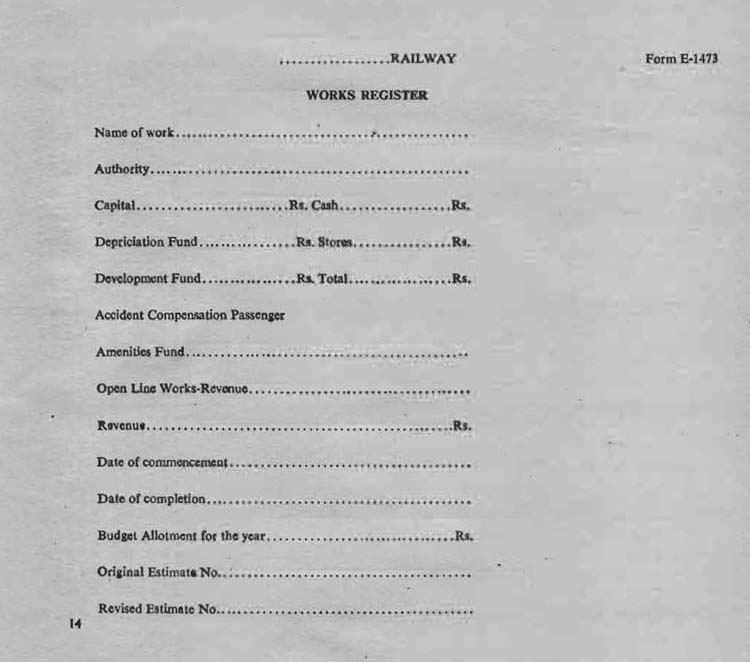
|
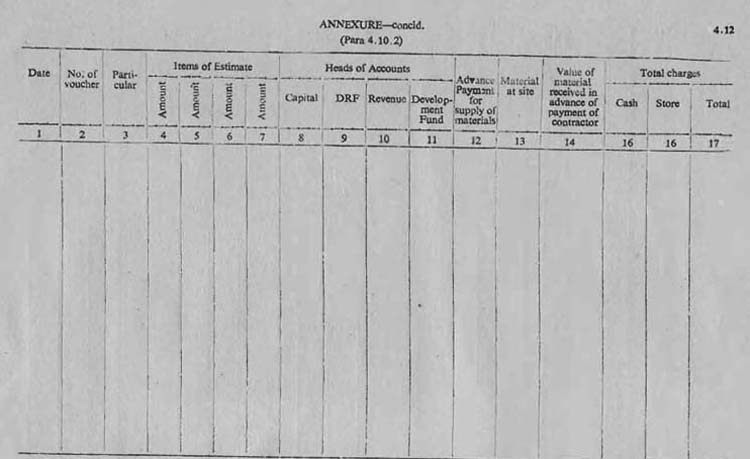
(3) This register should show the amount of estimate sanctioned, the budget allotment and details of expenditure on each work by heads of accounts and in addition under sub-heads of estimates in case of track renewal works estimated to cost Rs. 3 lakhs and over and Rs. 1 Lakh over and in the case of other works. In this register sub-heads of estimate estimated, to cost less than Rs. 10,000 need not be separately detailed, but may be grouped together as may be found convenient. The Register may be arranged by detailed heads of classification (for works falling under the demand relating to creation and replacement of assets) separate folios being set apart for each work. At the close of every month the register of works should be totalled up and the monthly, yearly and 'up-to-date' totals for each work struck. The register of works should be preserved for a period of 10 years. (Para 1474)
(4) In posting the Register of works in the case of works, the accounts of which are kept by sub-heads, the last column relating to each work will always show the ' total charges', the last column but one will show ' value of materials received in advance of payment to contractors', the last column but two will show the value of the 'materials-at-site' and the last column but three will show 'advance payment for supply of materials'. In case of works, the accounts of which are not kept by sub-heads, the value of 'materials-at-site' need not be separately shown but the value of materials received in advance of payment to contractor and advance payment for supply of materials, if any, should be shown in all cases. (Para 1475)
|
|
ANNEXURE '20'
(Para 4.12)
(1) Revenue and Works Expenditure.—As all Railway expenditure, other than that ' charged ' on the Consolidated Fund of India, is voted in the form of the Demands for Grants, the budgetary control is intended to ensure that expenditure is incurred for the purposes, and within the limits, as voted by Parliament. (Para 504)
(2) The exercise of authority for incurrence of expenditure carries with it also the responsibility for control of expenditure within the authorised limits. Further, these powers are subject to provisions contained in the various Codes, rules and regulations and also observance of the standards of financial propriety. (Para 505)
(3) Standards of financial propriety.—In the exercise of their financial powers, the sanctioning authorities must pay due regard to the following principles :— (Para 116)
(i) The expenditure should not prima facie be more than the occasion demands, and that every Government servant should exercise the same vigilance in respect of expenditure incurred from public moneys as a person of ordinary prudence would exercise in respect of the expenditure of his own money.
(ii) No authority should exercise its powers of sanctioning expenditure to pass an order which will be directly or indirectly to its own advantage.
(iii) Public moneys should not be utilised for the benefit of a particular person or section of the community unless—
(a) the amount of expenditure involved is insignificant ; or
(b) "a claim for the amount could be enforced in a court of law ; or
(c) the expenditure is in pursuance of a recognised policy or custom.
(iv) The amount of allowances, such as travelling allowances, granted to meet expenditure of a particular type, should be so regulated that the allowances are not on the whole sources of profit to the recipients.
(4) Revenue Expenditure.—The revised and budget estimates of ordinary working expenses submitted by the General Manager to the Railway Board are based on detailed estimates of revenue expenditure obtained by him from the various heads of departments of the railway. On receipt of the allotment from the Railway Board, these detailed estimates may require modification consistent with the allotment sanctioned by the Railway Board or as may be deemed necessary by the General Manager. (Para 506)
(5) Within the amounts of the allotments fixed by General Manager for the various spending authorities in charge of divisions and departments, such authorities have full power to sanction expenditure on revenue account during the year, subject to the condition that the specific sanction of the competent authority must be obtained separately to all items of expenditure on establishment and experimental or special temporary works where under rules or orders such sanction is necessary ; in a case in which the General Manager has prescribed that detailed estimates should be prepared and administrative approval and technical sanction obtained before the incurrence of expenditure, the procedure laid down by the General Manager must be followed. (Para 508)
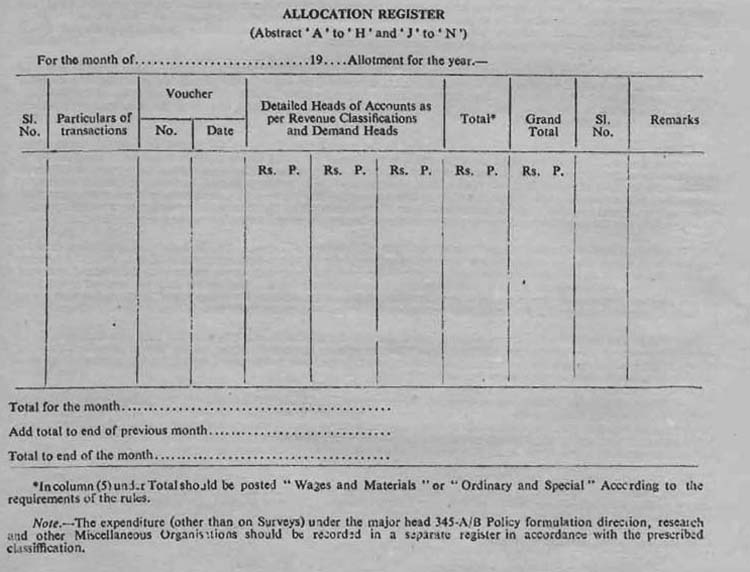
(6) Revenue Allocation Registers.—All revenue expenditure is to be recorded in registers, which are known as Revenue Allocation Registers, by the various heads of accounts. The object of these registers is to keep the heads of divisions, and departments informed of the progress of expenditure against the allotments placed at their disposal by the General Manager, which should be entered in red ink in the appropriate columns provided for in these registers, so as to form a ready means of comparsion and check with the outlay. (Para 512)
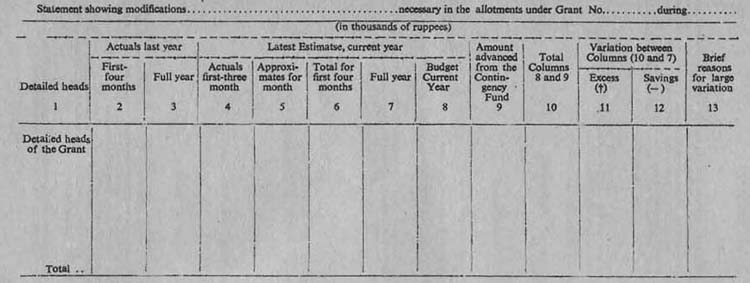
(7) Monthly Financial Reviews.—The monthly reviews show the expenditure to the end of the previous month, against the allotments placed at the disposal of the controlling authorities under each sub-head of the grant for which they are responsible. The review should be prepared in Form No. 513 and submitted to the controlling authorities every month, by such date as may be fixed in consultation with them. .
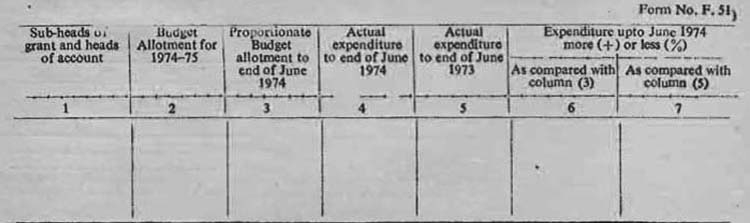
Note.—The periods have been shown in the Pro forma for the purpose of illustration only. 14A
|
|
(8) Expenditure on, acquisition construction and replacement of Railway assets.—Separate allotments are placed at the disposal of Railway Administrations under each Grant for expenditure on works chargeable to Capital, Depreciation Reserve Fund, Development Fund, Accident Compensation, Safety and Passenger Amenities Fund, or Open Line Works Revenue. These allotments are made in lump sums and their distribution over the various sub-heads and over the works for which they are intended are spelt out in the " Works, Machinery and Rolling Stock Programmes " which are furnished to the Railways also with the Budget Orders sanctioning the allotments. These 'Programmes also show, in the case of works costing over Rs.50,005 each, the total estimated cost of each work, and the railway administrations are required to exercise a control over expenditure not only against the allotment
sanctioned for the year for each works but also against its total estimated cost as shown in the Programmes'. In regard to works costing not more than Rs. 30,000 each, a lumpsum is allotted to each Railway administration in the ' Programme', before any expenditure is incurred against the lumpsum allotment ; the estimates of such works should be sanctioned by the General Manager or any lower authority empowered by him in this behalf. Thus the control of expenditure on railways is exercised through—
(i) the preparation, in advance, of estimates of the expenditure to be incurred ;
(ii) the allotment of funds through Budget Grants for the year, on the basis of these estimates ; and
(iii) the continuous and concurrent review of the expenditure as incurred against the details of the estimates and against the sanctioned grants, so that revisions of estimates or re-appropriation of funds are arranged for at the earliest possible point of time.
The procedure to be followed in Controlling expenditure against estimates is detailed in Chapter XIV and XII of the Indian Railway Code for the Engineering and Mechanical Departments, respectively. (Para 517 )
(9) Watch over Progress of Expenditures.— From the moment expenditure or liability is incurred on works, a check a regular and frequent intervals should be made on its progress, both against estimates and against funds. The check should originate in the lowest executive unit, Viz ., a division. (Para 520)
Note.—Estimates are prepared for New Minor Works costing over Rs. 5,000 each which are chargeable to "Open Line Works-Revenue ". The provisions in paragraph (10) apply equally to such works.
(10) The Works Registers (Form No. E. 1474) maintained in each division enable a running comparison to be made between- (Para 521)
(a) the expenditure incurred on each work and the detailed provision made in the estimate for the work, and
(b) the budget allotment for the work and the actual expenditure to the end of the month.
The executive officer should examine the works registers monthly or at more frequent intervals, and watch the progress of expenditure on each work, so that any tendency towards excess over sanctioned estimates may be investigated and curbed or fresh administrative and technical sanctions obtained in time to cover the anticipated excess.
(11) Review of Expenditure.—The Accounts Officer should prepare every month two reviews, one by sub-heads/Plan heads of the Grant and the other by individual works, and present them to the authorities concerned by such dates as may be fixed in consultation with them. (Para 524)
(12) The review of expenditure chargeable to Capital, Depreciation Reserve Fund, Development Fund, Accident Compensation, Safety and Passenger Amenities Fund Open Line Works—Revenue by sub-heads/Plan Heads of the Grant should be prepared monthly by the Accounts Officer in Form No. F. 525. (Para 525)
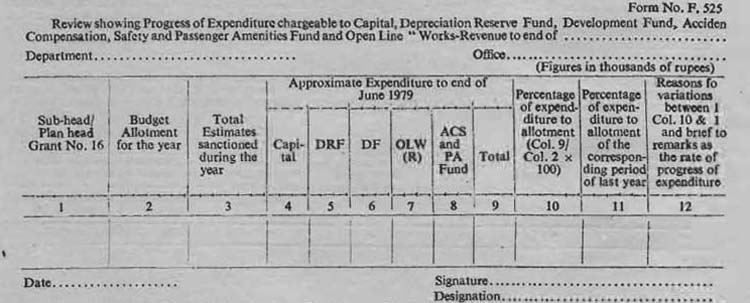
The quarterly reviews for period ending June, September and December may be sent to the Board by 25th of the second following month to which the figures relate. The review for the period ending March, will be sent to the Board by 6th August, each year.
Reasons for variations and brief remarks as to the rate of progress of expenditure to be indicated in Col. 12 of the Form, should be meaningful and should be recorded in consultation with the spending authorities.
|
| ANNEXURE '21'
(Para 4.14)
(1) Completion Estimates.—In the case of Railway Projects costing over rupees one crore, the Construction or Abstract Estimate should be closed at the end of one of the first three financial half years after the date of " opening " (as defined in para 2) as maybe convenient and a "completion estimate" prepared. The completion estimate is a "stock taking estimate" and all works not started on that date are excluded from the scope of the project and are to be dealt with separately. (Para 1701)
(2) In the case of open line projects the date of "opening " should be held to be the date on which the projects fulfills he purpose for which it was sanctioned. (Para 1702)
(3) Closing the Accounts of a Project.—Those items of work which were in progress at the time of closing of Construction or Abstract should be got completed and the accounts of the project should be closed as soon as possible. Executive Engineers in-charge of project should therefore take prompt action to bring to account all charges and credits pertaining to the projects. They should before closing the accounts of a project, take steps to liquidate all outstanding liabilities, clear suspense balances, pay up all outstanding contractor's claims and dispose of all surplus stores and tools and plant returned from works. After all charges and credits relating to the project have been booked in the accounts of the project a Completion Report of the project should be prepared. . (Para 1704)
(4) Form of Completion Report—The Completion Report should be prepared in the following form and brief explanations should be furnished for—
(i) excess of not less than 10 per cent or Rs. 25,000 whichever is less over the estimated provision under each sub-work ;
(ii) saving of not less than 20 per cent or Rs. 1 lakh whichever is less, occurring under any sub-work. (Para 1706)
Note.-The Divisional Railway Manager/Deputy Chief Engineer concerned may be empowered by the General Manager to approve the completion reports of works within the General Manager's competence in the Works Registers if variations are within 5 per cent of the sanctioned estimate.
Completion Report for the work........ Form E. 1706
| Particulars (Heads of Account and Description of works) |
Amount of Estimate (with reference to authority for sanction) |
Actual Expenditure |
Difference |
Remarks and Explanations |
| Excess |
Saving |
| . |
. |
. |
. |
. |
. |
(5) Completion of Works.—In common with works costing over Rupees one crore, a work or scheme costing less than this amount should be considered as completed when it fulfils the purpose for which it, when sanctioned, was intended, and when there has been no expenditure thereon for three months thereafter. All outstanding debits and credits pertaining to a completed work should as a rule be adjusted in the account of the work within three months of the date of completion. The accounts of a completed work should be closed six months after the date of completion and a completion report of the work drawn. (Para 1708)
(6) A completion report for works costing Rupees one crore and less should subject to the detailed instructions issued by the Railway Administration, be prepared in the same form as that for works costing over Rupees one crore. It should compare the actual expenditure incurred with the sanctioned amount and should give under each sub work brief explanations of all excesses and sayings of over 5 per cent or Rs. 10,000 whichever is less. The authority sanctioning the estimate may prescribe any additional information to be submitted along with the completion report. (Para 1709)
(7) A certificate to the effect that necessary addenda or corrigenda to the list of Buildings have been issued should be recorded on all completion reports for staff quarters and other buildings. A certificate to the effect that the necessary entries have been made in the siding registers and the register of deposit works should be recorded on all completion reports relating to assisted sidings and deposit works. (Para 1710)
|
|
(8) A completion report duly verified by the Accounts Officer should ordinarily be submitted to the authority who accorded the administrative approval to the work for information or regularisation. In respect of structural and track renewal works costing over Rupees ten lakhs included in the sanctioned budget with the prior approval of the Railway Board, and works sanctioned out of turn with the administrative approval of The Railway Board being beyond the General Manager's power of sanction, the completion reports may be finally dealt with by General Managers except (a) when they involve an excess beyond the General Manager's powers of sanction or (b) when a material modification is involved. For works costing rupees one crore and less the completion report should be submitted within six months of the completion of work. In the case of works on which no expenditure is recorded for
three consequtive months, the Accounts Officer should call for the completion reports. If the works are incomplete the executive officer should advise the Accounts Officer of the probable dates of completion and submission of the completion reports. Abnormal delay in the submission of reports by the executive officers should be brought to the notice of the Head of the Railway Administration by the Accounts Officer. (Para 1711)
(9) Completion Reports of Unfinished Works.—If for any reason a work on which expenditure has been incurred is stopped and if there is no reasonable prospect of completing it in near future, the account of the work should as in the case of a completed work, be closed and a completion report drawn and submitted to the authority which accorded the administrative approval to the work, for information. In the case of structural works, other than Track Renewal works, costing more than Rupees one crore each for which administrative approval of the Railway Board is obtained by the submission of separate Abstract Estimates notwithstanding their specific inclusion in the sanctioned budget, the completion reports in such cases should be submitted to the Railway Board, duly verified by the Financial Adviser and Chief Accounts Officer. (Para 1713)
(10) Completion Statements.—As a general rule, a completion report should be submitted in respect of each completed work. Neverthless, in the case of works, the expenditure on which is within the competence of the head of the railway to sanction, a formal completion report on the prescribed from need not be prepared. In such cases all the information required in the Completion Report form, the certificate of the Accounts, Officer and the sanction of the competent executive authority may be recorded in the register of works under the relevant accounts Completion Statements showing the following information being prepared and recorded under the orders of the competent executive authority, after verification by the Accounts Officer:— (Para 1714)
(i) Reference to estimate.
(ii) Amount of sanctioned estimate.
(iii) Actual expenditure as finally booked.
(iv) Brief explanation of excess or saving.
Note.—The provisions of this paragraph do not apply to works, for which detailed estimates are not required to be prepared.
(11) Expeditious closing of Accounts of Works.—The account of a work costing rupees one crore and less should not be kept open beyond three months of the date of its completion. Efforts should be made to bring to account all liabilities and credits pertaining to the work by liquidating the former and realising the latter within that period. If a contractor's claim could not be finally settled within that period whatever the railway considers as legitimately due to the contractors should be adjusted by debit to the work and credit to " Deposit" and the account of the work finally closed. If the disposal of released materials is likely to delay the closing of the account of a work, credit should be afforded to the work on the basis of estimates by the Stores Department in consultation with the Engineer. (Para 1715)
(12) Entry in the Register of Works.—When a work is completed and its accounts closed, a double red ink line should be rated below the last entry in the Register of Works and a note made as under— (Para 1716)
Works completed.
Completion report submitted on............................................
|
|
ANNEXURE-' 22 '
(Para 5.1.2)
Preparation of the Preliminary Works Programme
Extract from the Indian Railways Code for the Engineering Department
609. The Chief Engineer of the Railway will be primarily responsible for ensuring that the proposals prepared by the various departments are complete in all respects and are correctly prepared. The overall priorities within the ceiling given by the Board will also be fixed by him in consultation with the General Manager and other Heads of Departments. He will be responsible for the preparation and timely submission of the Preliminary and the Final Works Programme.
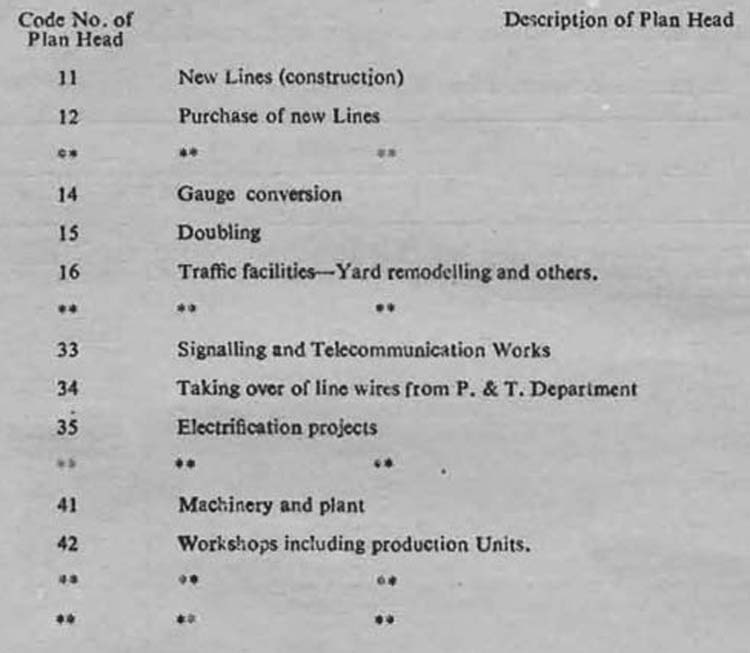
610. In or about June/July each year the Railway Board should convey to each Railway, in respect of each Plan Head, the total outlay within which the Works Programme should be framed by the Railway. A list of the Plan Heads is given in Annexure I. On receipt of this financial ceiling the Railway Administrations should take stock of the schemes already formulated and those under consideration and select for inclusion in the Works Programme within the financial ceiling such works as are expected to yield the maximum benefit to the Railway, preference being given to works in progress. Further necessary changes in the investments schedule may be made in order to work within the financial ceiling for the year such modifications being taken note of in framing the Preliminary Works Programme and revising the financial implications, if necessary.
611. The Preliminary Works Programme for the following year should be submitted by the Railways to the Railway Board by 1st week of September or such earlier date as may be laid down by the Board. Proper financial appraisal of each work should be given in the Preliminary Works Programme together with the comments 91 the Financial Adviser and Accounts Officer.
612. The project cost should be based on firm data both as to quantity and rates at current price levels, and should any increase occur in prices during the period intervening between the initial preparation of the project estimate and its inclusion in the Works Programme, the estimate should be updated taking into account any significant changes in the wages and material prices as well as increase in freights and fares. No other increase such as on account of change in scope of the project should be allowed without prior reasons being adduced for acceptance by the Railway Board. A sketch showing the proposal should accompany each proposal.
613. Each investment proposal should be accompanied by a detailed plan showing the scheduling of the project to match the traffic requirements and the financial outlay proposed for the year should be in accordance with this project schedule to enable the Railway Board to arrange for a realistic funds allocation for implementation of the programme.
614. in deciding the outlays for the various works Railway Administrations must endeavour to progress all works in progress speedily and bring them into use at the earliest possible date. A work which has been sanctioned and for which funds have been allotted whether in the original or supplementary budget of a year should be treated as a " Work in progress " for the next year and provided for as such in the programme. Such works should be grouped as indicated in para-619.
615. The Railway Administrations should make realistic assessment of the amount required for each work in progress and necessary provision should be made for it in the Works Programme. In estimating the provision for works during the budget year a generous allowance should be made for those delays in execution which though unforeseen are known from experience to be so liable to arise particularly prior to inception and during the initial stages of large projects. The provision made should take into account adjustment of charges on surveys connected with a project.
616. In exhibiting the outlay for the current year against individual works in the works programme, the outlay should be as per Pink Book, and in exceptional casts where the Railways propose any substantial increase in the outlay with corresponding reductions against other works, such revised outlay may be shown separately in brackets below the outlay as furnished in the Pink Book duly explaining the reasons for doing so in foot notes at the appropriate places. As far as possible only the last sanctioned cost should be exhibited. Wherever it is visualised that the cost would involve an excess over the last sanctioned cost, effective steps should be taken well in time to have the revised estimates prepared and sanctioned by the competent authority before the Works Programme is sent to the Board. In case where the revised estimates are sanctioned subsequent to the despatch of the final Works Programme but before the end of January of the
following year, the same should be promptly advised to the Board to enable the latest sanctioned cost being exhibited in the Pink Book to be circulated along with the Budget. In all cases of revised costs sanctioned by the Board, reference to the letter of sanction should invariably be indicated.
617. Works once introduced through a Works Programme (including Track Renewal Programme) and taken up after the estimates have been sanctioned by the competent authority should continue to be included every year till they are finally completed, except in cases where the works have reached the completion stage and where funds required if meagre could be found by reappropriation. |
| ANNEXURE '22' concld.
618, The Works Programs is compiled in the following format —
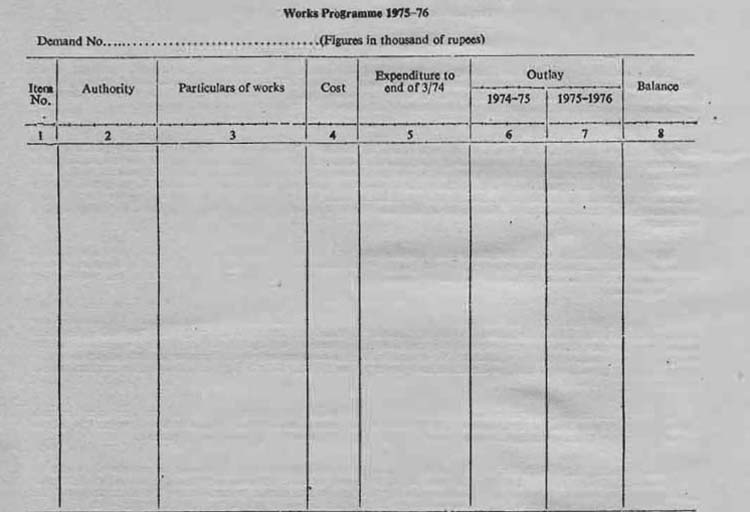
Note—'Years have been shown in the form for the purpose of illustration.
In respect of" Works in Progress "reference to item No. of the current year's Pink Book and also the authority under which the work was first started should be indicated. The works should be arranged as per the Plan Heads.
619. The items in the Works Programe should grouped under the following categories while compiling the works Programms.—
(i) New Works.
(ii) Works in Progress.
(iii) Works approved in earlier years, which have not been actually commenced and on which no expenditure has been incurred till 30th June of the year previous to the Programme year.
(iv) Works approved in the earlier years but estimates for which have not been sanctioned by 30th June of the year previous to the Programme year.
620. The works are further made into sub-groups of (i) Works costing more than Rupees Five Lakhs each, and (ii) works costing upto Rupees Five lakhs each. Under (iii) Works costing upto Rupees two lakhs each in the case of Track Renewal works and for works costing upto Rupees one lakh each in the case of other works, only lumpsum provision should be showa without detailing individual works. Within each sub-group, the works are presented under each Plan Head.
|
|
ANNEXURE 'B'
(Para 5.1.6)
Test of remuneratiteness
Extract from Indian Railway Financial Code/Vol. I
204. Test of remnnerativeness.— The net financial gain expected to accrue from a project may be either by way of savings in expenditure or increase in the net earnings (i. e., gross earnings less working expenses), or a combination of both. Except in the case of residential buildings, assisted sidings and rolling stock to which special rules are applicable no proposal for fresh investment will be considered as financially justified unless it can be shown that the net gain expected to be realised as a result of the proposed outlay would, after meeting the working expenses (see Para 217), yield a return of not less than 10 per cent on the initial estimated cost.
Note— (1) Interest during construction should be added to the cost (excluding that chargeable to Revenue) of the projects, the construction of which is likely to last for more than one year.
(2) Depreciation should be calculated on the total cost of the scheme and not only on the portion chargeable to Capital, unless the contrary procedure can be justified in any particular case. However, depreciation as an element of working expense is to be ignored for assessing annual cash flows under the B. C. F. method (See Para 228).
(3) In the case of construction of bridges, maintenance charges should include, besides the maintenance charges on the qridgs proper, the maintenance charges of the training works also.
|
|
ANNEXURE '24'
(Para 5.2)
Code Rules for Estimates
Extracts from the Indian Railways Code for the Engineering Department—
701. Kinds of Estimates.— All proposals for—
(a) the construction or purchase of new works or assets ;
(b) the renewals and replacements of existing works or assets chargeable to Depreciation Fund/Development Fund or Open line Works—Revenue when estimated to cost more than Rs. 10,000 ; or if chargeable to Revenue when estimated to cost more than Rs. 50,000.
(c) the scrapping, dismantlement or abandonment of existing works or assests ;
(d) the repairing or reconditioning, if estimated to cost more than Rs. 50,000 of existing works or assets ;
(e) temporary and experimental works ;
(f) renewals and replacements on worked lines, and
(g) renewals of ballast.
Should, subject to the provisions of paragraph 1103 regarding urgent works, be scrutinized by the authority competent to sanction them before any expenditure or liability is incurred thereon. For the purpose of this scrutiny, all such proposals should be presented in the form of one or other of the following estimates, according to the- circumstances mentioned in paragraphs 702 to 713.
(a) Abstract Estimates.
(b) Detailed Estimates.
(c) Supplementary Estimates.
(d) Revised Estimates.
(e) Project Abstract Estimates.
(f) Construction Estimates.
(g) Completion Estimates.
Note.— (1) for "New Minor Works" costing Rs. 5,000 and less, for renewals and replacement works chargeable to Revenue costing Rs. 50,000 and less and for " Reconditioning Works " costing Rs. 50,000 and less detailed estimates need not be prepared for formal sanction. Rough estimates should, nevertheless, be prepared and kept on record by the Executive Engineer.
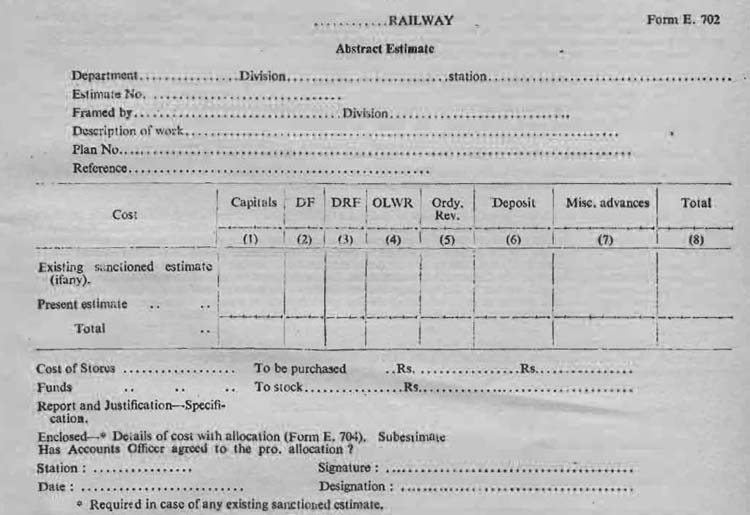
702. The Abstract Estimate.— An abstract estimate is prepared in order to enable the authority competent to give administrative approval to the expenditure of the nature and the magnitude contemplated, to form a reasonably accurate idea of the Probable expenditure and such other data sufficient to enable that authority to gauge adequately the financial prospects of the proposal. Abstract estimates avoid the expense and delay of preparing estimates for works in detail at a stage when the necessity or the general desirability of the works proposed has not been decided upon by competent authority. An abstract estimate should contain a brief report and justification for the work, specifications and should mention whether funds are required in the current year and to what extent. It should also show the cost sub-divided under main heads and sub-heads or specific items, the purpose being to present a correct idea of the work and to
indicate the nature of the expenditure involved. The allocation if each item as between Capital, Development Fund, Open Line Works-Revenue, Depreciation Reserve Fund and Revenue should be indicated.
Note.—(.1) Administrative approval to a work or scheme should be accorded by the authority competent to do so (vide paragraph 748), after a through examination of its necessity, utility and financial propspects. See also rules in Chapter II of Indian Railway Financial Code. |
703. Detailed Estimates.—On receipt of administrative approval to a project or scheme other than that for which construction estimate in Form E. 553 is prepared and, conveyed through the sanction to the abstract estimate relating thereto detailed estimates for various works should be prepared and submitted for technical sanction of the competent authority. It should be prepared in sufficient detail to enable the competent authority to make sure that the abstract estimate sanctioned by a higher authority is not likely to be exceeded. No work included in an abstract estimate should be commenced till a detailed estimate for the same is prepared and sanctioned and adequate funds are allotted by the competent authority. The detailed estimate of an open line work will comprise (i) statements showing details of estimated cost and (ii) an outer sheet giving the abstract of cost of work,
the report, the financial justification and the allocation.
Note.-Technical Sanction.—-The sanction of the competent authority to the detailed estimate of a work is called the " technical sanction ". The authority according technical sanction should satisfy itself that (i) the details of the scheme as worked out are satisfactory, (ii) the methods proposed for the execution of the work are adequate ; and (iii) the cost has been estimated from reliable data and is likely to be reasonably accurate.
(2) In the case of works within his power of sanction, the General Manager may, in lieu of the procedure of preparing Abstract Estimates for administrative approval, prescribe that both the administrative approval and the technical sanction should be accorded on the detailed estimates.
707. A supplementary estimate should be prepared for any item of work, which ought to have been included in the first instance in an estimate already sanctioned but has not been so included, or which it is found later, should be considered as being a part or a phase of an estimate already prepared and sanctioned, if it cannot be met out of contingencies (see paragraph 727). Such ,a supplementary estimate should be prepared in the same form and the same degree of detail as the main estimate and for all purposes be treated as a part of the main estimate.
708. Revised Estimate.—As soon as it becomes apparent that the expenditure on a work or project is likely to exceed the amount provided therefor in the detailed estimate or construction estimate a revised estimate should (subject to provision of paragraph 1336) be prepared and submitted for the sanction of the competent authority. It should , unless otherwise ordered by the sanctioning authority, be prepared in the same form and the same degree of detail as the original estimate and should be accompanied by a comparative statement showing the excess or saving under each sub-head of account against the latest sanction. In cases where a supplementary estimate; or a previous revised estimate has been sanctioned by the Railway Board, it should be made clear how the original sanction has been modified by such further sanctions.
709. The Project Abstract Estimate.—The abstract estimate of a Construction Project should be submitted for the approval of the Railway Board on Form E. 554 " Abstract cost of Railway " accompanied by (i) an abstract estimate of junction arrangements, (ii) a narrative report explaining the salient features and major items of expenditure (iii) detailed estimates on Form E. 553 prescribed for a construction estimate under the following heads :—
Capital—1120—Land Structural Eugineerong Works.—1132—Tunnels, 1151 and 1152—Major Bridges, 1153 and 1154 Minor Bridges, 1140—Ballast and Permanent-Way (Detailed estimate for one kilometre). 1180 and 1190-----
General Charges—Establishment and General Charges—Other than Establishment. 2000—Rolling Stock.
Note.—-Head shown above are for Plan Head ' New Lines' as an example.
Those detailed estimates should be prepared from an engineering survey report.
Note.—'The abstract estimate for an unremunerative project chargeable to Development fund will be prepared in the same detail as the abstract estimate for a construction project chargeable to Capital.
710. The Construction Estimate.—When it is decided to undertake the execution of a new line gauge conversion, or doubling of lines a final location survey should be made ; and based on the information collected in that survey detailed estimates of all the works included in the project as a whole should be prepared (of paragraph 540). These detailed estimates are collectively called the " Construction Estimate " of the Project. It should be prepared after a careful examination of the various details of construction involved in the Project. It should be in such detail as to render it possible to dispense with working estimates or any other further estimating after the Construction Estimate has been sanctioned (except when supplementary or revised estimates are necessary). It should provide for the buildings and equipment of the Railway upto a standard that will be sufficient for working such traffic as may be expected
during the first year or two after opening of the line. It is the basis on which technical sanction to the various works included in the construction of a Project is accorded.
713. Completion Estimate.—-A Completion Estimate is prepared in super session of a construction estimate as provided in paragraph 1701. It should show in a tabular form (E. 713) the following particulars in respect of all the works included in the construction estimate :—
(i) amount of sanctioned estimate ;
(ii) actual expenditure on all works up to the date of construction estimate ;
(iii) commitments on that date ;
(iv) anticipated further outlay ;
(v) total estimated cost ; and
(vi) difference between the sanctioned estimate and the estimated cost.
An abstract of the completion estimate showing the above particulars against the various heads of capital classification should be submitted for information or sanction, vide paragraph 1703 to the Railway Board together with brief explanations for excesses of not less than Rs. 10,000 or 10 per cent over the provision under sub-heads of account and for savings of 20 per cent or one lakh, whichever is less, occurring under any main head of account. Provision for further outlay should be made in completion estimate only for those works which are in progress or completed on the date of closing of the construction estimate. All works not started on that date should be dealt with separately as open line works both as regards estimate and expenditure. In forwarding, therefore, estimates for sanction for works in connection with new lines opened, it should be clearly indicated whether the cost of the work is chargeable to Capital Construction
or Open Line Capital.
Note.—The completion estimate of an unremunerative construction project chargeable to Development Fund will be prepared in the same detail as the original construction estimate using the various heads of capital classification for the purpose
714. Estimates for Railway Project—Scope. -A Construction Estimate (Form E. 553) should be prepared in such detail as to reduce to a minimum the probability of omission of any item of expense which is capable of being foreseen. It should be remembered particularly that the provision for contingencies allowed in the estimate is not intended to meet items of expense which can be foreseen and which are reasonably likely to occur. With good estimating it should seldom be necessary to encroach, to any appreciable extent, on the provision for contingencies.
727. Provision for contingencies.—Provision for unforeseen contingencies should be made in all estimates at 3 per cent of the total estimated cost. All incidental expenditure which can be foreseen such as works establishment, sheds for workmen and stores should be separately estimated and provided for in the estimates. The provision for contingencies should not be diverted to any new work or repair which is not provided for the estimate, and of which the cost exceeds Rs. 1,000 without the sanction of the authority who sanctioned the estimate.
729. Schedule of Rates.—To facilitate the preparation of estimates, a schedule of rates of each kind of work commonly executed should be maintained in each open line division, and it will be the duty of the Chief Engineer when inspecting the divisional offices, to see that correct schedules of the rates at which work is actually being carried out, ate invariably recorded in a complete and satisfactory manner. The regulations for the due record of rates in a clear and systematic manner and for their periodical revision to bring them on line with the rates prevailing in the market and those paid by other government departments will be laid down by the General Manager.
Estimates of Deposit Works
732. A Railway Administration is occasionally required to execute works for and at the cost of other Government departments, local bodies, private persons, etc. Such works are referred to in this Code as " Deposit Works " (see also paragraph 1843 for a definition of this term). To meet the cost of plans and estimates of such works as also those to be carried out for other Departments out of Railway funds, which are subsequently not carried out, charges at the following sliding scale shall be levied on the total of the estimate inclusive of departmental charges :-
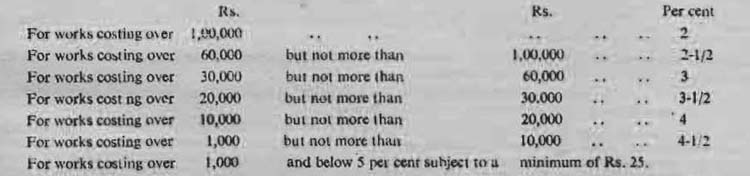
The acceptance of the government departments or the payment in cash by the local bodies or private individuals concerned should be obtained to the above percentage charges before the work of preparation of plans and estimates is taken in hand In cases where the proposed works are subsequently carried out, these percentage charges should be adjusted against departmental charges.
The levy of the above percentage charge may, at the discretion of the General Manager, be waived in particular case subject to the conditions laid down in paragraph 1138.
Note.—'The scale of charges prescribed in this rule does not apply to assisted sidings, recovery of preliminary expense in respect of which has been separately provided for under paragraph 1825.
733. In preparing estimates of works for other departments, local bodies, private individuals, & c, particular care should be taken to see that.
(i) Railway freight and carriage charges of materials proposed to be used in the works are provided for at the rates applicable to the public and not at the concessional rates applicable to railway material ; (Works of Branch Line Companies are not governed by this rule, but by the relevant contracts).
(ii) departmental charges at the prescribed rates (paragraph 1137) are provided for.
734. All estimates of deposite works should be got accepted by the parties ordering the works before submission to the competent railway authority for sanction. In the case of works, which under the rules (see paragraph 1851) are required to be maintained after completion by the Railway department at the cost of the department, local body, private firms or individuals ordering the work, the acceptance of the party concerned should also be obtained for the recurring expenditure that is likely to be incurred on repairs, maintenance, & c.
735. No work asked for by another government department should be commenced till a detailed destimate for the same has been accepted by the department concerned and sanctioned by the competent railway authority. No work asked for by local bodies, private individuals, and c, should be commenced till a detailed estimate for the same has been sanctioned the competent Railway authority and the estimated cost thereof deposited with the Railway. The amounts so deposited should be credited to the head "Deposits— Miscellaneous".
Competency of Sanction—
748. The previous sanction of an authority higher than the General Managers of Indian Railways is necessary :—
(i) To expenditure on new lines or rolling stock or surveys not provided in the sanctioned budget for the year or carried forward from the sanctioned budget of the previous year ;
(ii) To expenditure on other works not provided in the sanctioned budget or carried forward from the sanctioned budget of any previous year except :—
(a)
(i) Track renewal works- costing not more than Rupees two lakhs ;
(ii) Other works— costing not more than Rupees one laks ;
(iii) Machinery and Plant— costing not more than Rupees Fifty thousands.
Provided that the total lump-sum provision made in the budget for such works is not exceeded.;
(b) (i) On line capacity works costing above Rupees one lakh but not more than Rupees ten lakhs each ;
(ii) On track renewal works costing above Rupees two lakhs but not more than Rupees five lakhs each ;
(iii) On other than line capacity and track renewal works costing above Rupees one lakh but not more than Rupees five lakhs each ;
Subject to ceiling of Rupees one crore in all in a financial year provided that the sanctioned budget (other than lump-sum) for works in these categories is not exceeded.
Note — (1) The works thrown forward from previous years may be taken up only if the funds required for them can be found by reappropriation within the sanctioned allotment.
(2) The savings in the lumpsum provision made in the sanctioned budget shall not be utilized for the category o works in (b) above without the prior approval of the Railway Board.
(3) The General Manager may sanction expenditure on new works out of turn in respect of users' amenities including goods shed and booking office not exceeding Rupees one lakh in each case provided the funds required for such works as provided in the sanctioned budget for works in these categories is not exceeded; and expenditure upto Rupees fifty thousand in each case, in respect of existing Railway schools, institutes, hospitals and dispensaries provided the lumpsum provision in the sanctioned budget is not exceeded.
(iii) To expenditure on works provided in the sanctioned budget for the year or carried forward the sanctioned budget of any previous year as follows :—
(a) Works sanctioned under the lumpsum provision.—To an excess over the total lumpsum provision in the sanctioned budget for such works ;
(b) Works outside the lumpsum provision.—Rolling Stock, Track renewals and other works—to an excess over the estimated cost as entered in the sanctioned budget or sanctioned separately, as follows :—
(i) of more than 25 per cent over the original estimated cost ;
(ii) of more than 15 per cent over the first revised cost ;
(iii) of more than 10 per cent over the second and further revised estimated cost.
Provided further that all codal provisions regarding sanctions for material modification are strictly followed.
(c) Surveys.—To an excess over 10 per cent on original estimate sanctioned by higher authority (General Manager can sanction survey estimates costing upto Rupees one lakh each provided the surveys are included in the sanctioned budget)
Note.—(1) The works thrown forward from previous years may be taken up only if the funds required for them can be found by reappropriation within sanctioned allotment.
(2) The amount first given in the Budget or sanctioned separately by higher authority shall be the original estimated cost and the revised amount given in subsequent Budgets or sanctioned separately by higher authority, the second, third, etc., revised estimated cost.
(3) The powers of sanction to excess over estimated costs allowed in item (b) above shall not make the cost of such works exceed Rupees one crore in any case.
(4) The powers for sanctioning the excess over the estimated costs of works outside the lumpsum provision as in item (b) above shall not be redelegated to lower authority in respect of works, the original estimated cost of which is over Rupees fifty lakhs.
(iv) To the scale of—
(a) a portion of a Railway line;
(b) in item of the authorised Rolling Stock ; or
(c) any other Railway asset costing over Rupees three lakhs.
756. Currency of Sanction.—The sanction to an estimate will ordinarily remain current for five years from the date on which it has been accorded unless it has been renewed for a further term by the acceptance of a revised estimate. Acceptance by competent authority however, of a budget estimate which includes specific provision/for expenditure on a work which is in progress, may be regarded as reviving for the year in which provision is made, the sanction to the estimate-regardless of the five years' limit. But if no work has been commenced on a sanctioned scheme within two years of the date on which the sanction was accorded to the estimate, such sanction should be held to have lapsed and fresh sanction should be obtained from the competent authority by the submission of an up-to-date estimate, if necessary.
758. Scope of the sanction to an Estimate.—The authority granted by a sanction to an estimate should, on all occasions, be looked upon as strictly limited to the precise objects for which the estimate was intended to provide. Accordingly any anticipated or actual saving on a sanctioned estimate for a definite project should not, without special authority be applied to carry out additional work not contemplated in the original projector fairly contingent on its actual execution. Saving due to the abandonment of a substantial sanction of any project should not be considered as available for work on other sections
The Execution of Works
1102. The ordinary rule is that no work may be commenced and no liability or expenditure incurred on a work until a a detailed estimate for it has been sanctioned and an allotment of the requisite funds made by competent authority. This rule pertaining to preparation of estimates does not apply in the following cases :—
(i) For the construction or purchase of now work or asset under the category of new minor works if estimated to cost upto Rs. 5000.
(ii) For renewals and replacements of existing works and assets chargeable to Open Line Works Revenue as a new minor work if estimated to cost upto Rs. 10,000.
(iii) For renewals and replacements of assets charged to Development Fund and Depreciation Reserve Fund if estimated to cost upto Rs. 10,000.
(iv) For renewals and replacements of assets charged to Revenue if estimated to cost upto Rs. 50,000; and
(v) For repairs and reconditioning of existing assets if estimated to cost upto Rs. 50,000 (of para 701).
1103. Work started on Urgency Certificates.—In addition to the exception mentioned in the preceding paragraph the following are the only classes of work on which expenditure or liability may be incurred prior to the receipt of sanction of the authority competent to sanction the estimates under the ordinary rules :—
(l) Works, which are considered to be urgently necessary to safeguard life or property or to repair damage to the line caused by flood, accident or other unforeseen contingency, so as to restore or maintain through communication.
(ii) Works considered urgent but not falling within (i) above, as for instance, works required to meet the immediate needs to traffic, which are considered by the General Manager so urgent that they must be started before the earliest date by which detailed estimates could be prepared.
Note.—Where applicable the instructions in paragraph 1260 should be observed.
1105. In according administrative approval or sanction and in allotting funds, if required, the competent authority will give such instructions as ho considers necessary regarding the execution of the work to executive officers subordinate to him and fix a date by which the detailed estimate for the work should be prepared and got sanctioned. He will at the same time furnish a copy of his sanction and instructions to the Accounts Officers.
1109. Material Modifications.-No material modification in a work or scheme as sanctioned, should be permitted or undertaken without the prior approval of the authority who sanctioned the estimate. In the case of estimates sanctioned by the Railway Board or higher authority, instances of what will be considered to be a material modifications of a sanctioned project or work are given in paragraph 1110 below.
1110. The following may be taken as material modifications on lines under construction and open line works estimated to cost rupees one crore and over :—
(a) Any change in the alignment likely to affect the facilities offered to the public in the neighbour-hood or likely to increase or decrease the length of the line by over one kilometre.
(b) Introduction of any new station or omission of any station.
(c) Any alteration in the type or number of engines or vehicles provided in an estimate for rolling stock.
(d) A change in the layout of a yard affecting the general method of working or increasing or reducing the number of trains that can be dealt with.
(e) Any departure from the standards of construction as prescribed in Chapter II or as accepted by the Railway Board in the Abstract Estimate or use of any second hand materil if it affects the speed of trains or the number of trains to be dealt with than contemplated originally.
(f) The introduction or omission of any work or facility involving a sum of Rs. 5 lakhs and over.
(g) Any modification of a sub-work provided for in the estimate of a sanctioned work involving an additional outlay on that sub-work of more than Rs. 5 lakhs.
(h) The introduction of any new sub-work not provided for in the estimate of a sanctioned work involving an outlay of more than Rs. 5 lakhs.
(i) Any alteration in the standards of interlocking.
1137. Departmental Charges.—When work is undertaken by the Engineering Department of a Railway for outside parties, including other Railways, Government Department, Public bodies (e. g., Municipalities, Port Trust, etc.) and employees of the Railway, Departmental charges should be levied to cover the cost of tools and plant and of establishment supervision The charges leviable will be 12-1 /2 per cent on the total cost of the work (wages and materials) including the cost of land, except where a rate higher than 12-1/2 per cant is charged to Governmental Departments on a reciprocal basis. The charge will be levied once only on the total outlay on a work (cash and stores, and will not be addition to a first charge of 12-1/2 per cent on the value of stores, vide paragraph 2329-S.
Note.—(1) The above rules do not apply to works undertaken by Engineering Workshops to which the rules applicable to works undertaken in workshops of the Locomotive and Carriage and Wagon Department apply.
(2) Railway Units of the Territorial Army.-The charges under the foregoing rules may be remitted in the case of works not exceeding Rs. 500 in cost executed by the Engineering Department of a Railway for Railway Units of the Territorial Army provided that no additional establishment is entertained for such works.
1138. Remission of Departmental Charges.—The General Manager may, at his discretion, waive wholly or partially the recovery of the Departmental charges leviable under Paragraph 1137 provided that—
(a) the Railway gains some advantage, not necessarily financial, by such remission :
(b) the reasons for the remission are recorded in each case and the remission is allowed with the concurrence of the Financial Adviser and Chief Accounts Officer; and
(c) the non-incurrence of extra charges on accounts of tools and plant and establishment supervision does not in itself constitute sufficient justification for the remission.
|
|
ANNEXURE '25'
(Para 5.3.4)
Grouping of works
Extract from the Indian Railways Code for the Engineering Department
750. Grouping of works.- When two or more works are so connected either by their situation or by the purpose or purposes which they are designed to serve, that construction of one necessarily involve that of the other or others, the works should be considered as one scheme and the aggregate estimated cost of the work so connected should determine the authority competent to sanction expenditure on the scheme. When the works constituting a connected scheme are situated in more than one executive division separate detailed estimate should be prepared of the cost of the work in each division in order that the Executive Engineer entrusted with the actual construction may be in a position to watch expenditure against a sanctioned estimate of the cost of the work in his charge.
Allocation of Charge
Extract from Indian Railway Financial Code, Vol. I
776. Cost of Tools and Plants and Special Posts.- No portion of the pay or allowances of permanent open line staff shall be charged to Capital, Depreciation Reserve Fund, Development Fund or Accident Compensation, Safety and Passenger Amenities Fund or Open Line Works- Revenue, as the case may be, when such staff is employed on special works and the vacancies thus caused in the open line cadre remain unfilled. The cost (less return value) of tools and plant specially purchased and the cost of any posts specially created for the supervision or construction of a work chargeable purely to Capital or Depreciation Reserve Fund or Development Fund or Accident Compensation, Safety and Passenger Amenities Fund or Open Line Works- Revenue, as the case may be. When the cost of work is chargeable partly to Capital or Development Fund, Accident Compensation, Safety and
Passenger Amenities Fund or Depreciation Reserve Fund or Open Line Works- Revenue, the cost of such posts and tools and plant should be allocated to Capital or Development Fund or Accident Compensation. Safety and Passenger Amenities Fund or Depreciation Reserve Fund or Open Line Works- Revenue in the same proportion in which the estimate for the work excluding the estimated cost of tools and plant and special posts, is chargeable. For working out the proportion, the gross amount of the estimate (ignoring the provision for credits on account of released materials) should be taken into account. The cost of a post, for the purpose of this rule includes the leave salary and contribution towards passages, pensions provident fund, bonus and special contribution to provident fund, which the holder of the post may be entitled to.
Note:- The provision for credits on accounts of released materials to be ignored in working out the proportion of cost of tools and plants and special posts, should be the net credit in terms of paragraph 710(2). |
|
ANNEXURE '26'
(Para 6.2)
IMPREST STORES
Extracts from Stores Code—
1801. Definition of Imprest Stores.—Materials whether stock items or non-stock items, held in stock not for specific works but as a standing advance for the purpose of meeting day to day requirements in connection with the repair and maintenance shall, including consumable stores such as cotton waste, jute, oil, grease etc., be treated as imprest stores, so long as they are under the control of the authority in charge of the executive unit and have not been issued to works.
1802. Object of Imprest System.—The main object of the Imprest System is to control the expenditure on materials used each month in the running repairs of rolling-stock, etc. But this involves inter alia, effective financial and departmental control on the stocks of materials held at outstations and their issue and recoupment.
1805. Schedule of Imprest Stores.—Schedules of items of such materials showing the quantities of each item which should be held as an imprest should be prepared separately for each imprest holder. This schedule (S. 1805) shall show the following details;—
(1) Class of Stores. Form No. S. 1805
(2) Price List or part List Number.
(3) Brief description of Stores.
(4) Sanctioned Imprest.
(5) Rate.
(6) Value.
1806. Copies of the schedule and any subsequent modifications of it should be supplied to the Divisional Superintendent or the immediate superior of the imprest holders, the Stores Department and Accounts Officer, Stores, who should each keep the same up-to-date.
1811. Control of Imprests.—It shall be the duty of the controlling authority in charge of the imprest holders to see that the imprests are revised from time-to-time so as to ensure that they are the lowest possible both as regards quantity and value, consistent with actual working requirements. The imprest holder shall be held responsible to ask for a reduction or deletion of any item of imprest on the basis of the consumption in his shed or station.
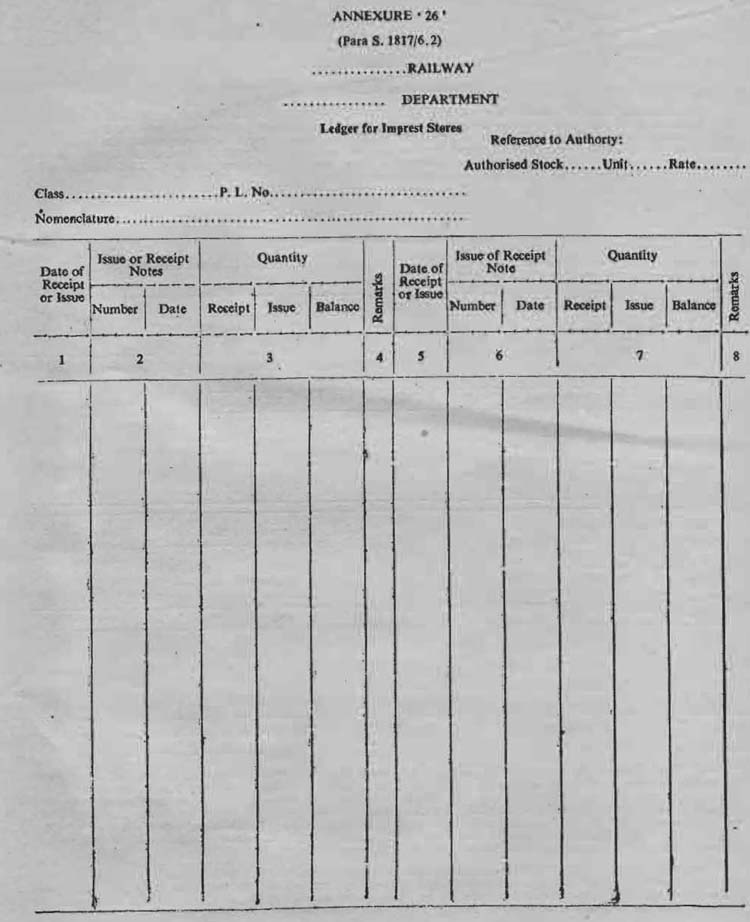
1817. Accounting.—Each Inspector holding imprest stores shall maintain a numerical ledger on Form No. S. 1817 (Annexure A-I) showing receipts, issues and balances of imprest materials. Each item of the imprest stores shall be dealt with on a separate page of the ledger.
1829. Closing of Ledgers and Recoupment of Imprests.—The Divisional or District Officers should fix the dates of accounting period for each imprest holder and intimate the same to the Accounts Officer, Stores.
1830. Each Imprest Holder should close his ledgers monthly on the dates fixed for him and check them with the Issue and Recoupment Schedule which should be prepared in the form shown below from the Monthly Summary of Issues (S. 18,23).
Monthly Summary of Issues- "Charged OFF" Stores Class- Form No. S. 1823
| Date |
P.L. No. |
P.L. No. |
| Allocation |
Allocation |
Allocation |
Allocation |
Allocation |
Allocation |
| Quantity |
Quantity |
Quantity |
Quantity |
Quantity |
Quantity |
| Total quantity for each head of account under each P.L. No. |
. |
. |
. |
. |
. |
. |
| Total Issues |
. |
. |
. |
. |
. |
. |
Note:- The need for the daily abstracts and monthly summaries provided for in paragraphs 1821 to 1823 does not arise in case the Issue Tickets (S. 1819) themselves are valued.
1838. Authority to Sign Indents.—Indents for recoupment may be made directly by the imprest holders under their signatures and the counter signature of District or Divisional Officers for such indents is not necessary.
Extracts from Engineering Code
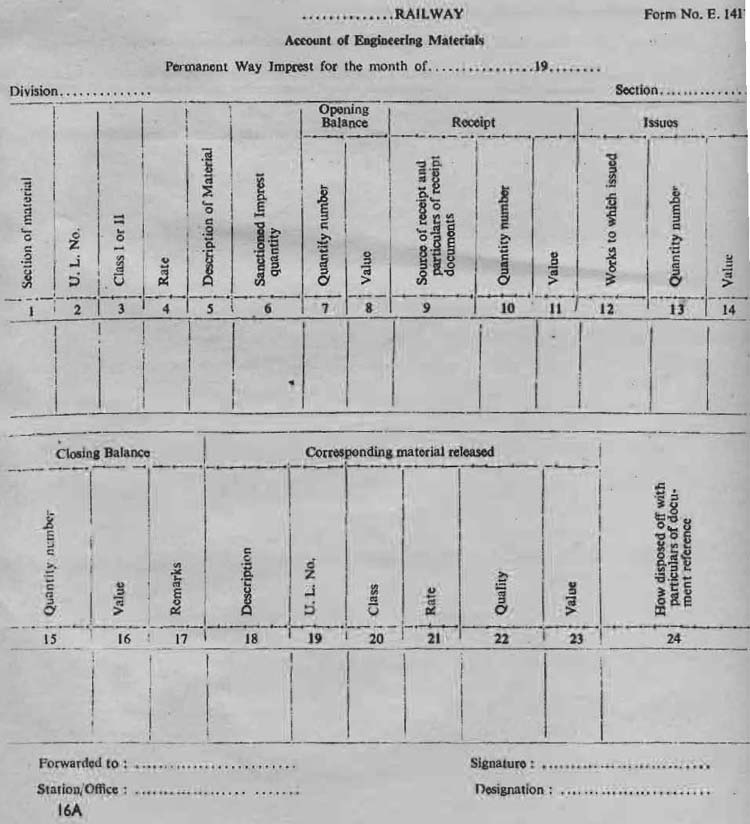
1417. Monthly Stores Returns.— At the close of each month, separate returns showing receipts, issues and balances of a items of imprest and surplus stores operated on during the month should be submitted by each engineering subordinate to the Divisional Officer through his Assistant Engineer. These returns are referred to in this Chapter as Imprest Stores Account and Surplus Stores Accounts and should be submitted in the form printed below (Form No. E. 1417). Both the accounts should as far as possible, be supported by the various receipt and issue vouchers, i. e., Issue Notes Adjustment Mema and Advice Notes. These accounts should bear a certificate from the subordinate concerned that no stores other than those included in the accounts have been received or issued during the month and that the balances of all items of stores not included in the accounts remain the same as at the
end of the previous month.
|
| ANNEXURE ' 26'
(Para 6.2)
1418. Check of Monthly Stores Returns.—In the Divisional Office, the Imprest and Surplus Stores Accounts (Form No. E. 1417) received from the subordinates should be checked to see—
(i) that the opening balances of the items appearing in the accounts agree with the closing balances of the accounts in, which the items last appeared ;
(ii) that all receipts have been taken correctly to account as debits ;
(iii) that the issues of materials are in order and reasonable and have been correctly taken to account as credits ;
(iv) that all transfers within the Division agree— i.e., that the issues in the account of one subordinate agree with the receipts in the account of another subordinate, any disagreement noticed being rectified and the subordinates concerned advised-of the correction ; and
(v) that, in the ease of Imprest Accounts, the sanctioned imprest has not been exceeded without proper authority.
|
| ANNEXURE ' 26 '
|
ANNEXURE ' 27'
(Para 6.5)
TOOLS AND PLANT
Extracts from Engineering Code
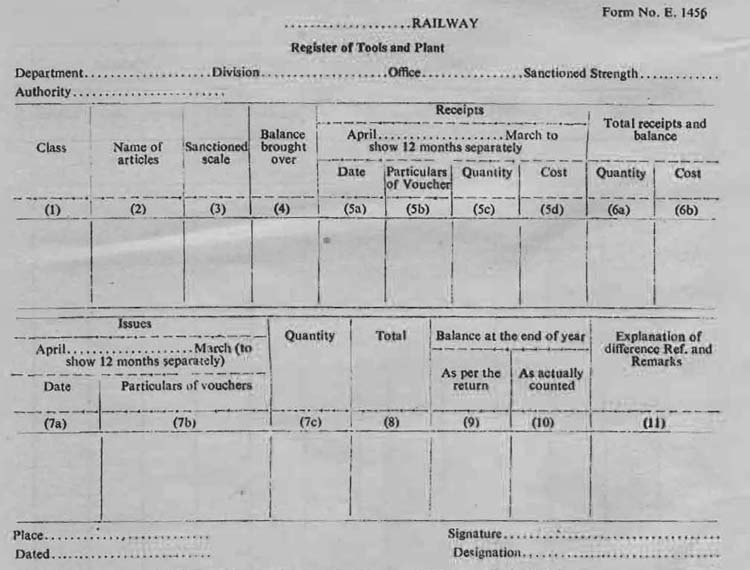
1456. Tools and Plant for Maintenance.— A scale of Tools and Plant will be fixed for each gang under a Permanent Way Inspector and the total with his gangs plus a small reserve in his own godown will form the scale fixed for each Inspector. A scale for tools and plant will similarly be fixed for other Engineering Supervisors. On issue to the permanent way and other Engineering Supervisors, the cost of these tools and plant is charged off finally. It will, therefore, be necessary for the Supervisors to maintain a tools and plant register (Form E. 1462) and submit it after the close of each financial year to the Divisional Office for check.
1457. The Permanent Way and other Engineering Supervisors should not retain in their hands any tools in excess of the number allowed in their scale. Should additional articles come into stock from any stores, the order of the Divisional Officer should be obtained through the Assistant Engineer for their disposal. If replacement of worn out, damaged or lost articles is required a requisition for the articles required should be submitted to the Divisional Office with an explanation of the Circumstances in which the replacement is applied for. The Divisional Officer will after satisfying himself so as to the correctness of the explanation, approve the requisition and pass orders for the disposal of worn outer damaged tools and for the recovery or write-off of the cost of lost tools.
The tools and plant register received the Divisional Office should be checked completely as regards arithmetical accuracy. The correctness of all items of receipts and issues should also be completely checked with relevant Issue Notes, Advice Notes , sanctions or writes-off, etc., and the discrepancies taken up. The registers should then be put up for the information of the Divisional Engineer who will, if he considers necessary, order any redistribution, of the tools.
|
| ANNEXURE ' 28 '
(Para 6.7)
Guidelines for preparation of Indents
A consolidated indent for the supply of uniforms for all the eligible sanctioned staff shall be prepared by the Divisional Signal and Telecommunication Engineer and submitted to the Controller of Stores for compliance. The indent shall be prepared in accordance with the following guide lines :—
(1) Clear description of Uniforms with Style number shall be furnished and the category of staff indicated for whom Uniforms are required.
(2) The year for which the supply is meant shall be furnished and fund certification indicated.
(3) Since one P. L. number has been allotted for one Style of all sizes, indents shall be submitted accordingly for one style duly indicating the required sizes for that style category wise, consignee wise for the entire Division and sent to Controller of Stores.
(4) For staff headquartered at places not coming under zones prescribed as " Winter or mild Winter " but who are required to be supplied with Winter uniforms due to their being rostered for travel during the course of their duty to " Mild Winter " and " Winter " places at least five times a month, a certificate to this effect shall be furnished on the reverse of the indent.
(5) Certificate to the effect that the styles and scales furnished are as per standing instructions shall be given in the indent.
(6) It shall also be certified that the size furnished are as per measurement card maintained for the staff concerned.
|
| ANNEXURE ' 29 '
Para 6.14
MATERIALS AT-SHE ACCOUNT
Extracts from the Engineering Code
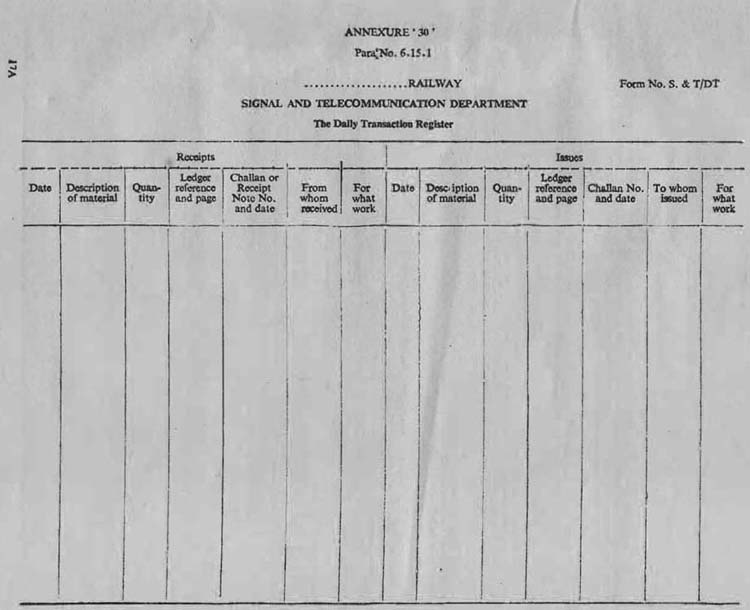
1441. Daily Record.—-The estimated value of works for which accounts are kept by such-heads in the Register of Works will be as provided for in Para 1486. A daily numerical record of receipts and issues of materials shall be maintained by the Stock holder in Form E. 1441.
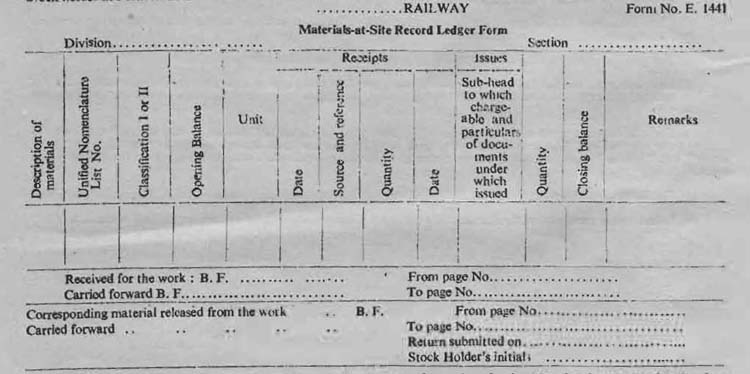
1442. Materials obtained for the work should on receipt, be entered as such under the 'Receipts' together with the date, quantity, issue notes or other reference. In the case of materials obtained by direct purchase particulars should be entered in a Measurement Book as well.
As materials are issued for consumption on the work, the date, the quantity and the sub-head to which they are chargeable should be recorded under 'Issues'. Materials so issued, but found subsequently to be surplus to requirements should be brought back into record as 'Minus Issues'. Such transactions should wherever practicable be avoided by confirming issues to exact and immediate requirements.
Materials released from the work should, on displacement be recorded separately as such and be entered with the date and quantity and disposal reference as 'Minus Receipts'.
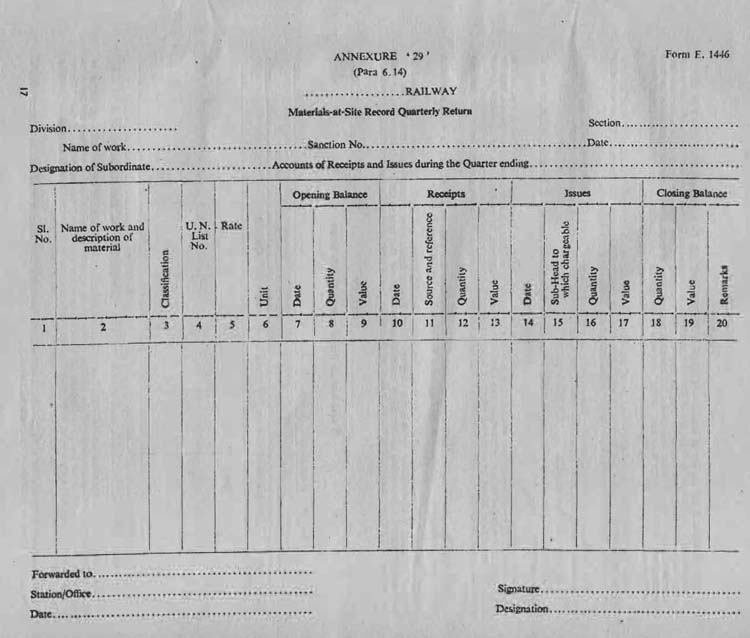
1446. Quarterly Materials-at-site-Returns. - The Supervisor who is executing the work and is also functioning as stock holder shall prepare a quarterly Materials at site account return (Form E. 1446) in respect of each work valued at Rs. 3 lakhs in the case of Track Renewal Works and Rs. 1 lakh in other works for which Register of Works is maintained by sub-heads of estimates, and send the same to the Divisional Office. This return should include only those items for which there have been any receipt or issues/transactions during the quarter. The quarterly return may be followed by a complete Materis-at-site account return return for all the items at the end of half-year ending September and March. A number of works may be included in one form provided that all such works are under the executive charge of the same authority.
1447. The check of Materials at site return.- The Materials-at-site returns received in the Divisional Office should be checked in the following respects:-
(a) The Opening balance should be checked with the closing balance of the previous return;
(b) The receipts during the period covered by the returns should be checked with the relevant issue notes, the summary of stores, adjustment mema and other receipt vouchers;
(c) The reasonableness of the issues during the period covered by the return should be checked with reference to the relevant sanctioned estimate, and the progress of work reported during the period;
(d) As regards materials returned to Stores Depots or transferred elsewhere, the correctness of credits to site accounts should be checked with the relevant advice of returned stores or adjustment mema.
(e) The arithmetical accuracy of the returns should be checked. |
| ANNEXURE '29'
|
|
ANNEXURE'29"
Para 6.14
1448. Acconntal in the Register of Works.—All materials obtained specifically for a particular work should be charged off immediately to the head to which the cost of that work as a whole is allocated (or if more than one heed is involved to that bearing the greatest cost) ; but should, so long as they are not consumed on the work be borne under a suspense head "Materials-At-Site" opened under that head. All materials released from a work should also be borne under the same suspense head. The adjustment from the " MAS " suspense to the relevant final detailed heads should be carried out as soon as the materials are shown in the monthly return as having been issued for use on work.
1449. The responsibility for having a daily record maintained, a monthly return prepared, checked and valued and cost adjusted as prescribed in these rules devolves on authority in executive charge of the works. The Accounts Officer who maintain the works Register is responsible for the final adjustment of all materials-at-site transactions.
1450. Verification of Materials-at-site.-The authority in executive charge of works for which material at site accounts are maintained should arrange for a periodical verification of the following materials at site pertaining thereto—
(a) Permanent Way materials.
(b) Other materials at site which can be readily separated and distinguished from any of the same description but of different category.
It is not necessary that all articles should be checked at the same time; but every item should be verified at least once in a year. A certificate by the authority in executive charge of works that such verification has been carried out should, together with a note as to whether or not the materials were found to be unduly depreciated, be furnished on the materials at site return for the month of March, or on the last return on which a balance is shown, submitted in the year. The stock verification prescribed in this paragraph is in addition to the periodical stock verification of engineering stores arranged for by the Accounts Officer.
1452. Daily Record.—A daily numerical record in respect of materials-at-site works in this category for which a separate account is not maintained by sub-heads in the Register of Works shall be kept in Form E. 1441.
1453. Monthly Return—At the end of every month, an Excess Materials Return in Form E. 1453 given below should be prepared in respect of all completed works in this category. These Returns should show separately for materials obtained and materials released, the numerical balance only of materials-at-site i. e., those that have neither been consumed on the work nor returned to the stores, transferred or otherwise disposed off and the date of completion of the works to which they relate.
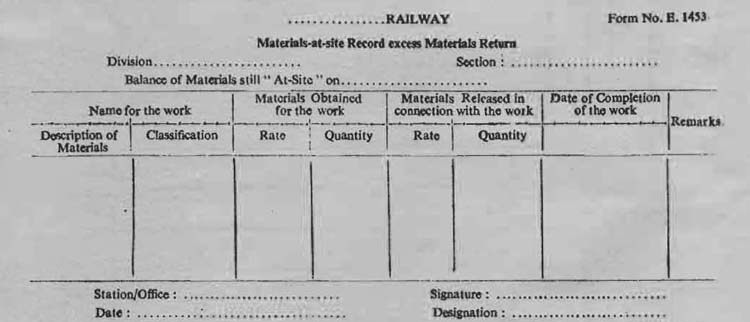
1454. Check of Excess Materials Returns.—The Excess Materials Returns should be checked in the Divisional Office as regards the correctness and reasonableness of the balances shown therein against the various receipt vouchers and the sanctioned estimates and put up to the Executive Engineer for his orders as to the disposal of the balances. If the ' Excess Materials' cannot be utilized on some other works, they should either be returned to the Stores Depot or taken to Engineering Stores Surplus—(i) Permanent Way, (ii) other than Permanent Way ; (iii) Awaiting sale.
1455. Accountal in the Register of works.—Materials obtained specifically for particular works in this category should be charged off finally in accordance with their allocation.
|
| ANNEXURE '30'
|
| ANNEXURE ' 31 '
Para 6.16
RETURNED STORES
Extracts from Stores Code
1601. All Stores which have been previously issued for the services of the Railway and are no longer required on a work should, in the absence of special instructions to the contrary, be returned to the Stores Depots. If there is more than one Stores Depot on a Railway, the Controller of Stores may nominate the depot or depots to which particular classes of Stores may be returned and advise the various Railway departments accordingly.
1602. Advice Notes.—The Officer Returning Stores to Stores Depots should prepare Advice Notes in Form (S. 1539) in six foils by carbon process. Separate Advice Notes should be prepared for each class and for new, second hand and scrap stores.
1604. Disposal of the Foils of Advice Notes.—One foil of the Advice Note should be retained by the subordinate returning the Stores to the Stores Depot as his office copy, three foils (the 2nd, 3rd and 4th) should be sent to the depot direct along with the Railway Receipt. Of the remaining two copies, one copy (the 5th) should be sent to the Accounts Officer, Stores, and the other (the 6th) to the Divisional or District Officer through the immediate superior of the subordinate returning the Stores.
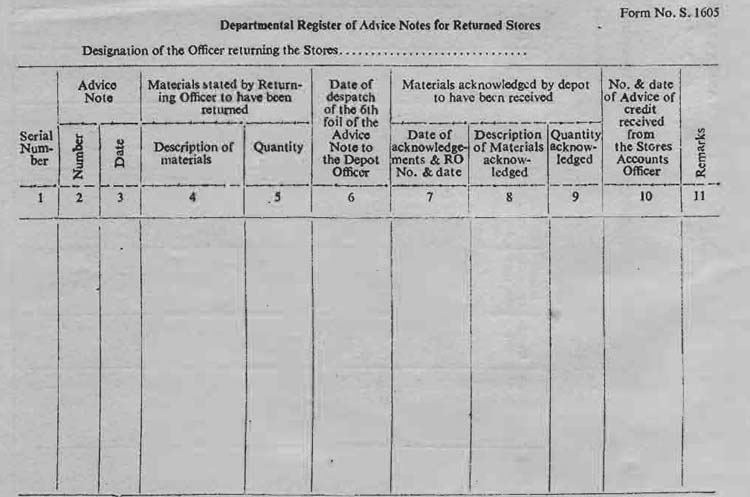
1605. Departmental Register of Advice Notes.—The Advice Notes (6th foil) should be carefully examined in the division or district office to see that they have been correctly prepared. They should then be listed in a Register of Advice Notes for Returned Stores maintained in the form shown below :—
|
|
ANNEXURE ' 31'
Para 6.16
1606. A separate page of this register should be allotted to each returning officer or subordinate as may be found convenient. If the particulars furnished by the subordinates returning the stores regarding nomenclature, rates, etc., are found to be incomplete, the Advice Notes (S. 1539) (6th foil) should be completed in the divisional or district office in these respects. The Advice Notes (6th foil) should then be forwarded to the depot to which the stores have been returned.
1620. Posting Numerical Ledgers.—The Depot Officer, after having the necessary entries made in the numerial ledgers as well as in in the Depot Register of Advice Notes (S. 1608) should retain one copy of the Advice Note (2nd foil) as his office record and send the two copies (3rd and 4th foil) duly completed in all respects to the Accounts Officer, Stores.
1621. Disposal of Receipt (6th) Foil.—The sixth foil of the Advice Note should also be sent by the Depot officer duly receipted to the divisional or district officer concerned to be retained as the latter's office record after making the entries in columns 7 to 9 of the Departmental Register of Advice Notes (S. 1005). He should take up with the depot and returning officers any discrepancies in quantities (vide columns 5 and 9 of the Register) if the reasons given on the Advice Notes are not satisfactory.
1626. Advice of Credits.—From the 3rd foil will be prepared the Advice of Credits (S. 2705) according to the departments from which the stores have been received. The number and date of the Advice of Credit should be noted in the Accounts Register of Advice Notes (S. 1622) against the entries of the Advice Notes included in the Advice of Credits . The Advice of Credits with the 3rd foils as supporting vouchers and the corresponding 5th foils should then to sent to the divisional or district officer concerned.
1628. Procedure in the District or Divisional Office.—On receipt of the copies of the Advice Notes along with the Advice of Credit from the Stores Accounts Officer in the division or district office, the 5th foil should be transmitted to the subordinate concerned after noting on it the fact of credit having been received. The Advice of Credit supported by the 3rd foil should then be carefully checked with and noted in the Departmental Register of Advice Notes (S. 1605).
1607. The Register of Returned Stores (S.1605) should be inspected frequently to see that there is little avoidable delay on the part of the stores depots in acknowledging the stores. Any cases of omission to acknowledge the stores and/or to afford credit for the same within one month of the Advice Notes should be taken up with the Depot and Accounts Officers.
|
| ANNEXURE '32'
|
| ANNEXURE '32'
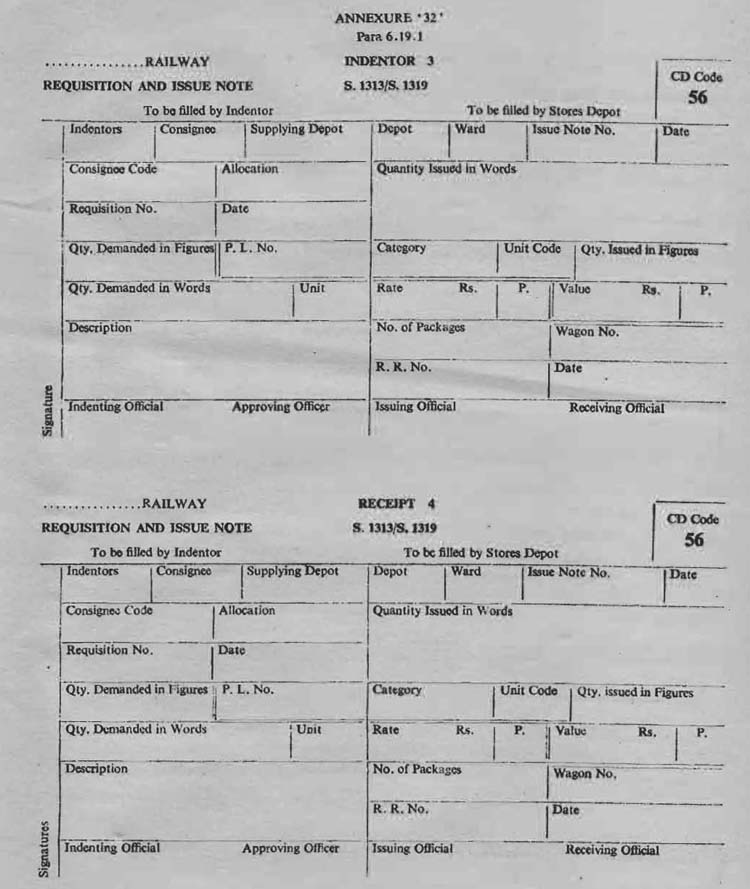
|
| ANNEXURE '32'
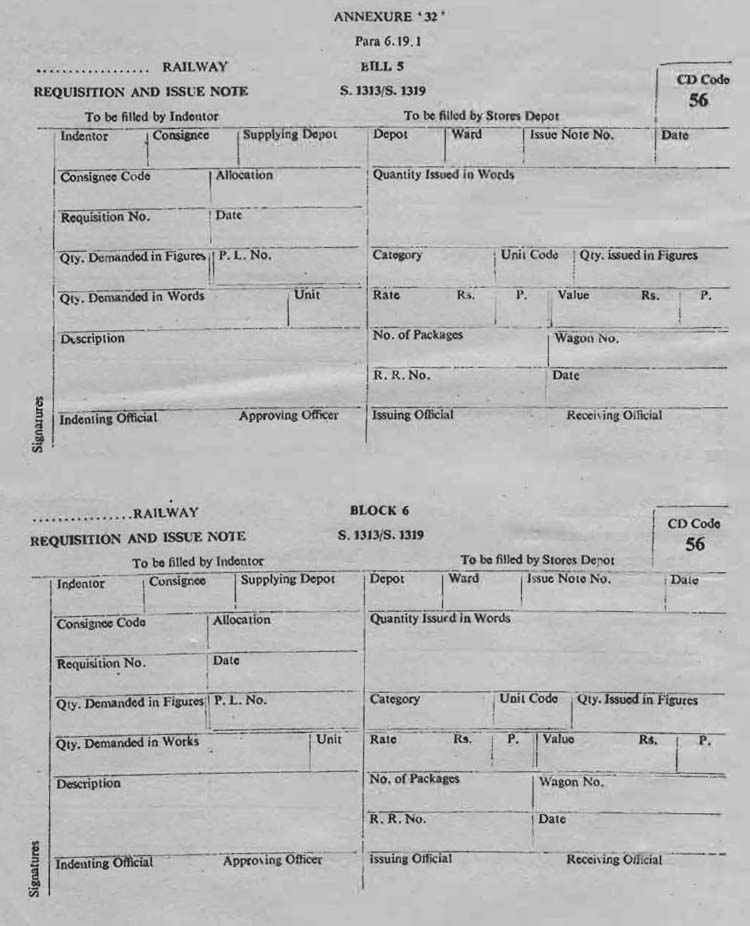
|
| ANNEXURE '32'
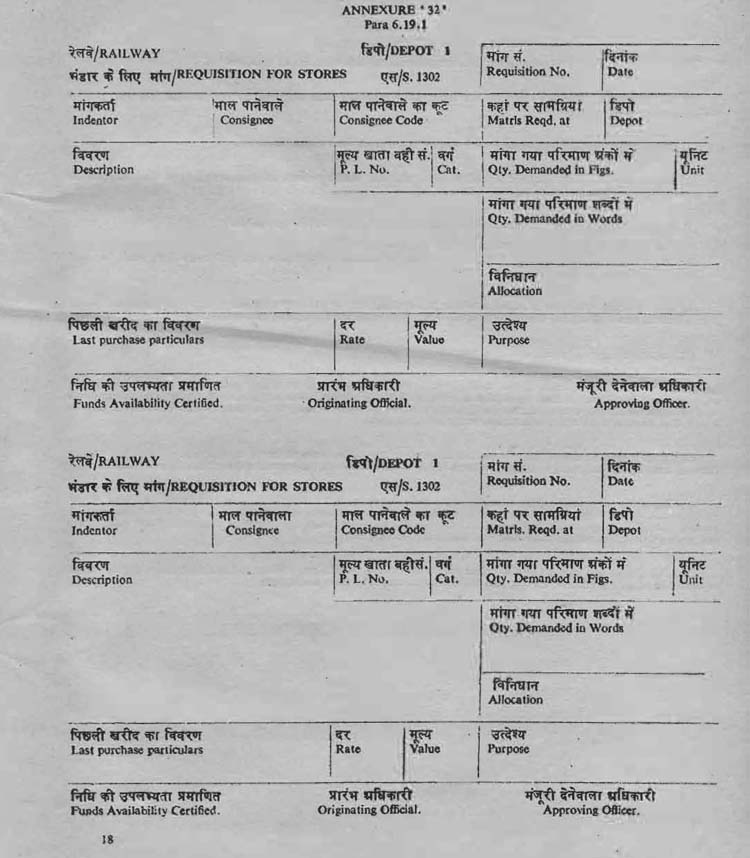
|
| ANNEXURE '33'
Para 6.22
General instructions for proper custody and Maintenance of Stores
(1) All materials shall be kept clean and free from dust. Materials liable to get rusted shall be kept free from rust by oiling/greasing whenever required.
(2) Stores enclosures shall be provided with weather proof protections where necessary.
(3) Materials shall be kept properly sorted and neatly stacked. Racks or other suitable arrangements shall be provided for storing any tools and petty consumable stores.
(4) Parts and small items of materials shall be kept in properly labelled bins or on shelves.
(5) Clutch Resetting Handles/Crank Handles/Electric key Transmitter keys, master keys and spare keys shall be kept locked up with the key in the custody of the Inspector.
(6) Bags of cement shall not be stored in too large a quantity nor for too long a period. Bags shall be issued strictly in rotation, the first bags is being the first to be issued out. Bags of cement damaged by rain or moist air shall not be issued.
(7) Point rodding shall be loaded in open wagons.
(8) Inflammable materials such as oils, spirits, patrol, etc., shall be stored separately and away from cotton waste, stationery and furniture. Naked lights and smoking shall not be allowed inside such godowns. Adequate arrangements shall be made for fire protection, i. e., fire extinguishers shall be kept handy at easily accessible spots and fire buckets shall be kept full of water/or sand where inflammable materials are stocked.
(9) Cables should be stored properly without damage to the cable drum as far as practicable. Cable shall not be removed from drums until ready to install. When a length of cable is cut off, the exposed end shall be effectively sealed.
(10) Signalling relays shall be kept separately at a place where environment is not likely to be damp and free from chemical pollution due to acid fumes, etc. Relays shall be transported from one place to another carefully in box with " thermocole " packing to avoid damage during transportation. Similar care should be taken for upkeep of tokenless block instruments and other sophisticated materials like Axle Counters Relay Groups, etc.
(11) Paints shall be stored in a cool dry place away from flame or naked light. All containers shall be kept tightly closed to avoid loss of material due to skinning and contamination caused by open atmosphere.
|
| ANNEXURE '34'
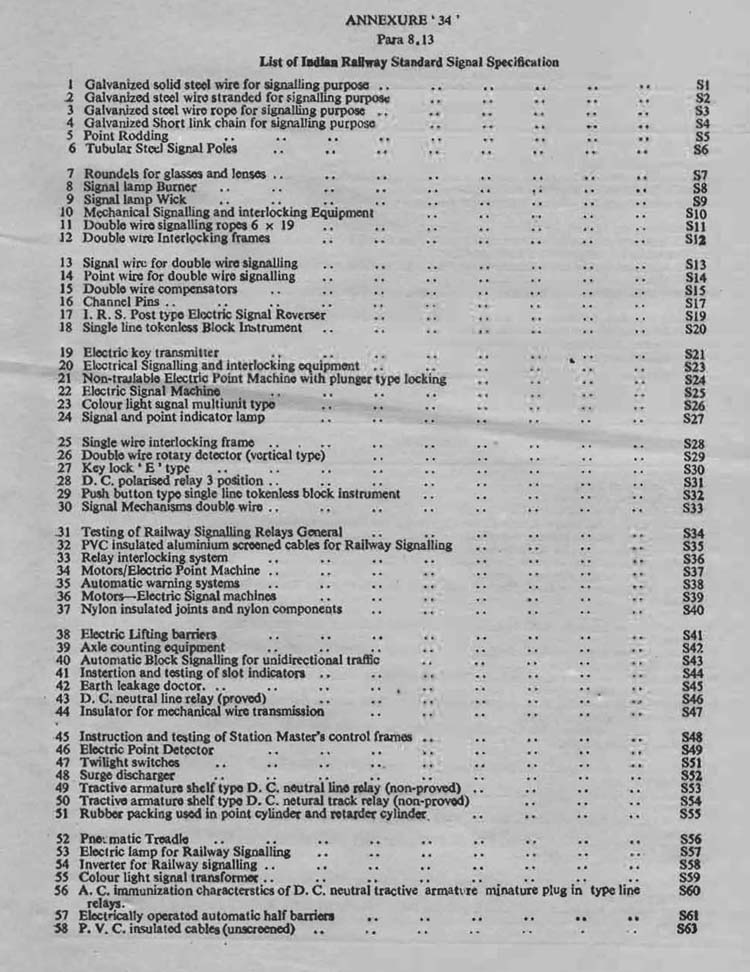
|
| ANNEXURE '35'
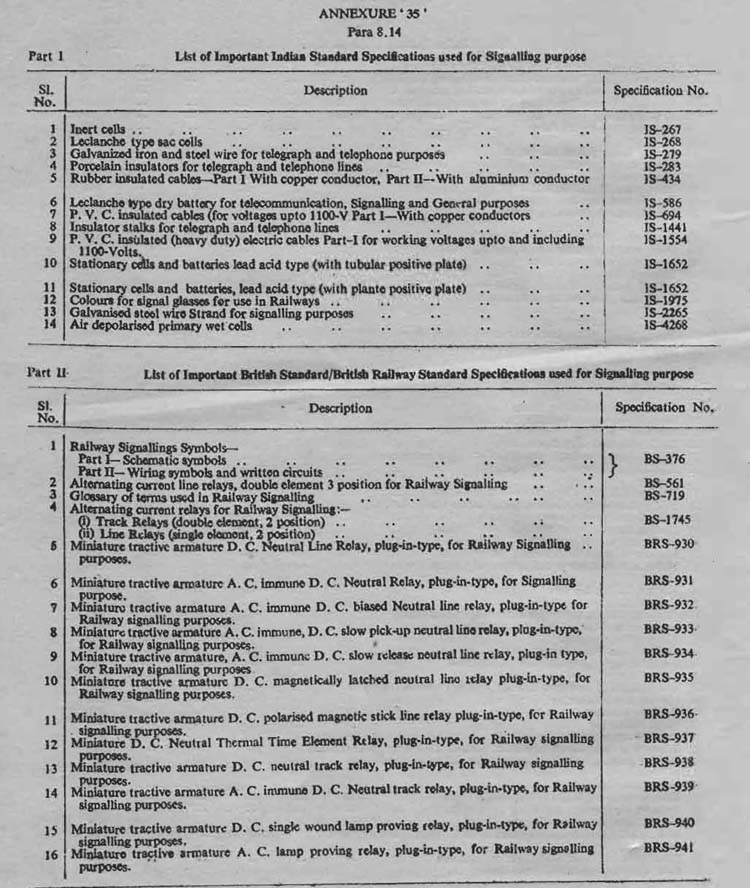
|
| ANNEXURE '36'
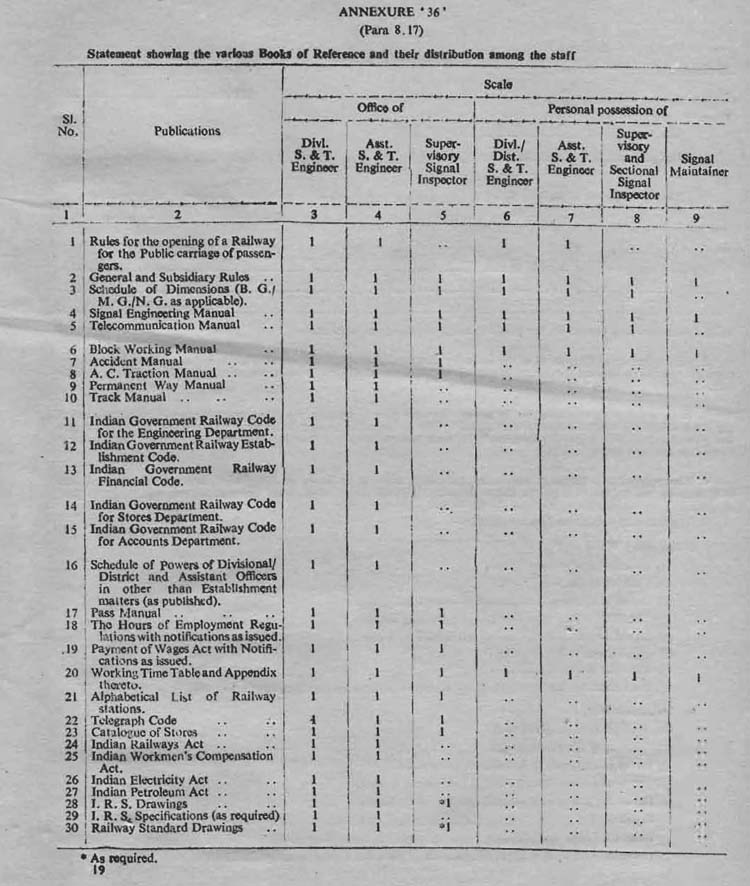
|
|
ANNEXURE ' 37'
Para9.7.1(iv)
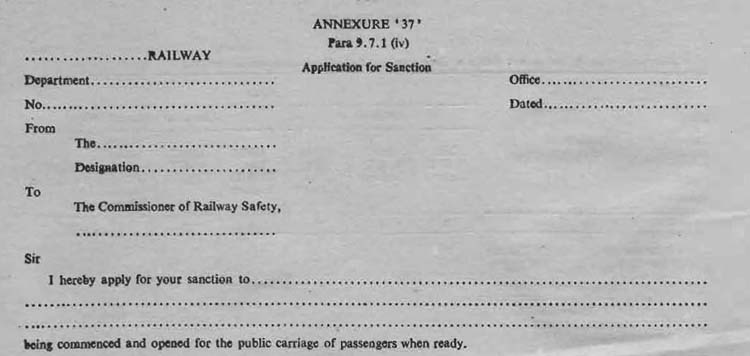
2. With reference to Chapter VI of the Rules for the Opening of a Railway, I have to enquire whether you wish to inspect the work prior to its opening for the public carriage of passengers, in which case intimation will be given of the date of completion.
3. In the event of your deciding not to inspect the work prior to opening, the Engineer-in-charge will, on completion of the work, submit the Safety Certificate, duly signed by him, prior to the opening of the work for public carriage of passengers and when required, also despatch a telegram to your address intimating that the work has been opened and the safety Certificate has been signed by him.
4. The application for the use of locomotives and rolling stock to be drawn or propelled thereby on the proposed line, in accordance with Section 16(1) of the Indian Railways Act, 1890 (IX of 1890), is sent herewith/not required.
5. The following documents @ are enclosed :—
I. Temporary Works :
(a) Description of proposed works.
(b) Drawing of temporary works.
(c) List of infringement to Schedule of Dimensions.
(d) List of deviations from the Signal Engineering Manual.
(e) List of deviations from General and Subsidiary Rules.
(f) Restrictions.
(g) Rules for Traffic Working.
(h) Documents for bridges as per Chapter VII of the Rules for the Opening of a Railway.
II. Permanent Works :
(a) Description of proposed works.
(b) Drawing of permanent works.
(c) List of infringement to Schedule of Dimensions.
(d) List of deviations from the Signal Engineering Manual.
(e) List of deviations from General and Subsidiary Rules.
(f) Restrictions.
(g) Rules for Traffic working.
(h) Documents for bridges as per Chapter VII of the Rules for the opening of a Railway.
6. Certified that a detailed examination of the strength and arrangement of the materials to be used in the temporary permanent works in above connection, have been made and that the design and the materials to be used are up to the loads, which they will be required to carry and that their opening for public carriage of passengers will not be attended with any danger.
(Delete temporary or permanent work, as the case may be)
Yours faithfully
Signature.................
Designation.............
Dated...................
No...........................
From
The Commissioner of Railway Safety,
........................................................
Sir,
Your No..................................................................
Sanction is accorded to the above work being carried out. % I do not propose to inspect the work prior to its opening for the carriage of passengers. When ready, it may be opened on a Safety Certificate (vide Paragraph 3 of your letter) which should be submitted to me direct without any delay.
% I propose to inspect the work prior to its opening for the public carriage of passengers. Advice of the date, when work will be ready for inspection should be intimated at least 14 days before it is proposed to open it.
.................................................
Commissioner of Railway Safety
*Here enter the name of work and mention whether permanent or temporary.
**Form of telegram : " Reference sanction No.................dated............................work open at for public traffic on........................First train to pass......................No danger to public. Certificate signed."
@ If any of the documents are not sent, then 'NIL' to be written against such items. Working rules for extensive remodelling scheme may be sent in not later than one month before the date on which the work is to be brought into use, and in such cases " will follow " should be written instead of " NIL ".
% Strike out paragraph not applicable.
|
| ANNEXURE '38'
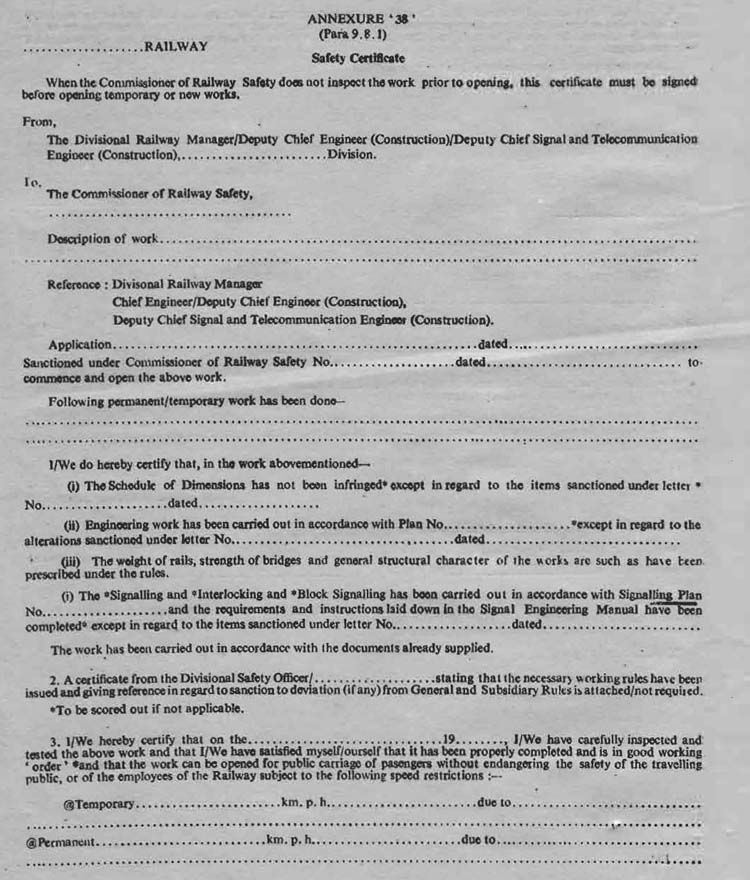
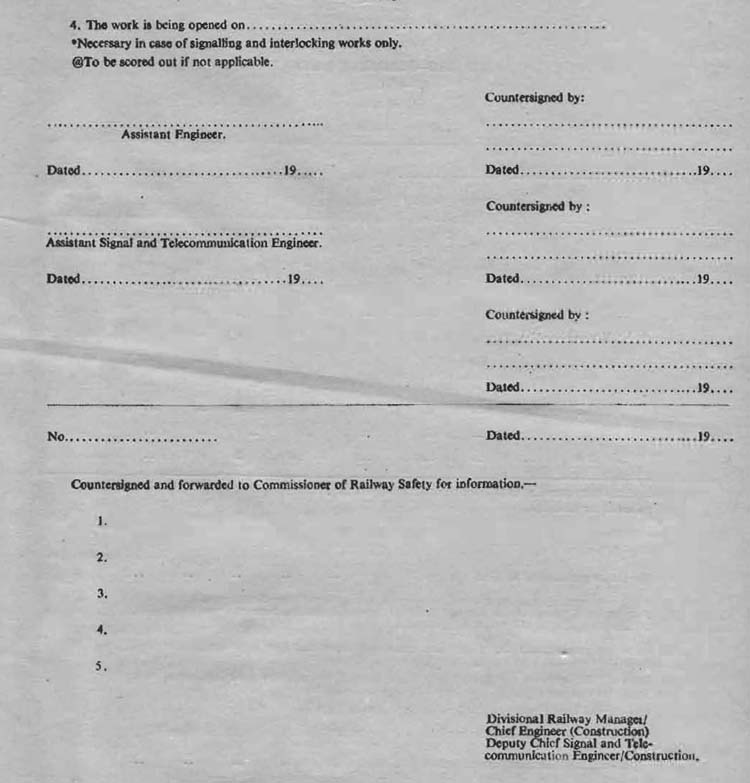
|
| ANNEXURE '39'
Para 9.9.2(i)
AMINABAD - BISHANPUR RAILWAY
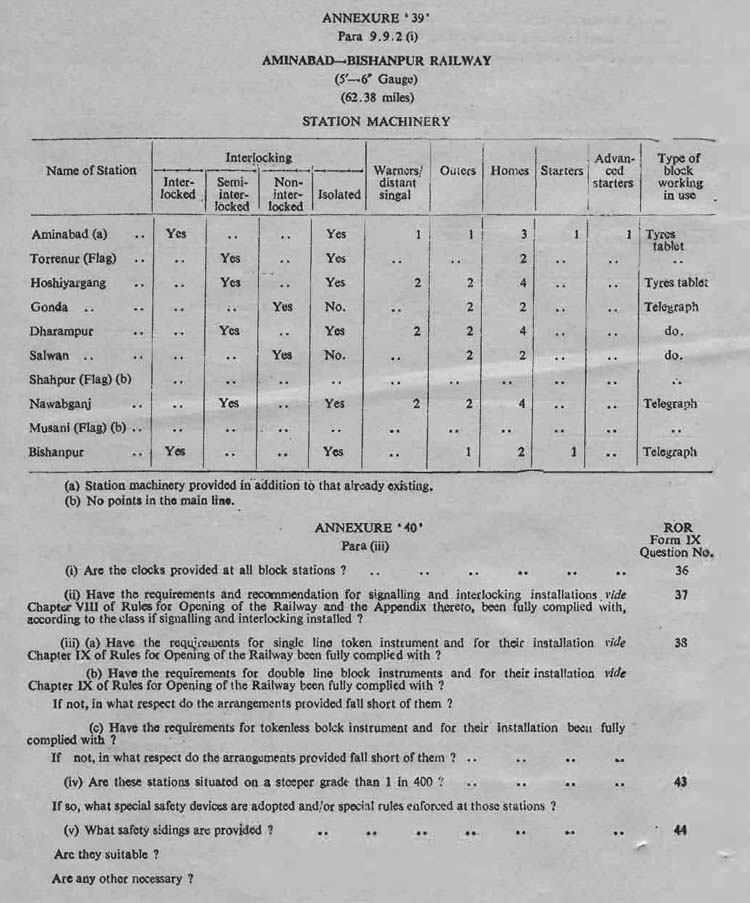
|
| ANNEXURE '41'
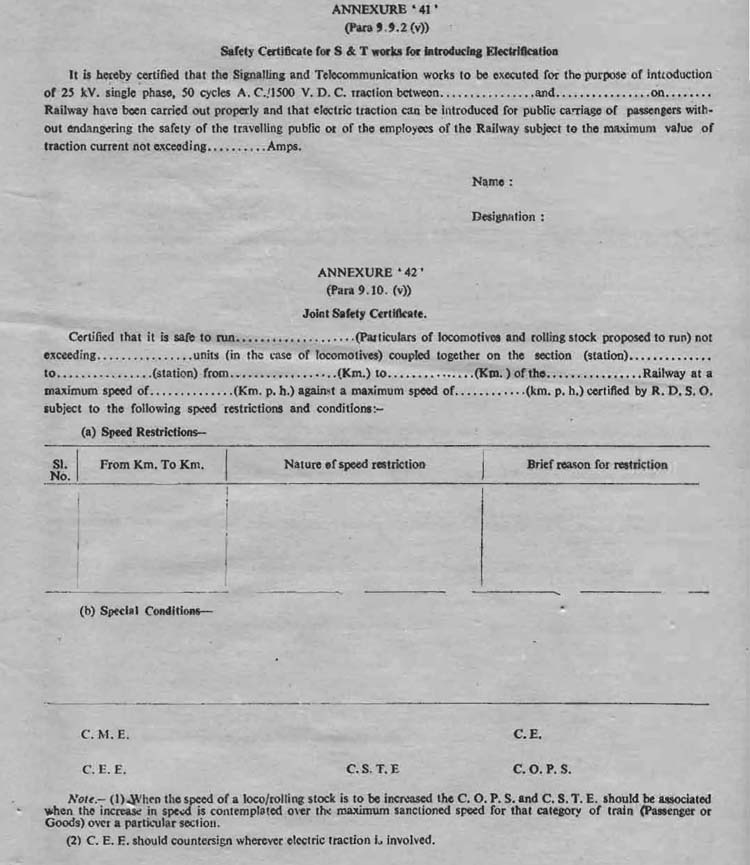
|
| ANNEXURE ' 43'
Para to.20.1 (ii) and 10.21.1
INSTRUCTIONS FOR SECURING MEASUREMENTS
1. The measurement book is the basis of all accounts of quantities of work done by contract and shall be so kepi that the transactions may be readily traceable into the accounts by the entry of the number and date of bill in this book when the bill has been prepared and the entry of the number and page if the measurements affected shall then be crossed red ink diagonally thus

2. All measurements ate to be taken down in ink in this book and in no others. The description of work must be lucid so as to admit of easy identification and check .The measurements shall show the quantities of work done as par last measurement and the total to date. A reference to the pages of the measurement book, where the previous measurements are to be found, also be given.
3. No erasures arc allowed. If a mistake is made, the wrong wordings or figures shall be neatly scored out and correct entries made. Every such correction shall be initialled.
4. For large works, a separate measurement book may be specially set apart, or if found convenient, even two or more books may be set apart for different classes of works.
5. The measurements book must be looked upon as important records ; they shall be carefully checked by the Engineer-m-charge to set that they are kept up as complete records of each kind of work done for which certificates have been granted. The eventual return of all books to the Divisional Signal and Telecommunication Engineer's Office for record shall be insisted upon.
6. Whenever an Assistant Signal and Telecommunication Engineer is required to submit his measurement book to the Divisional Signal and Telecommunication Engineer's Office, a Second book may be provided for his use where necessary.
7. Whenever progress on a work is reported in lump sum quantities under sub-heads of works, the number and page of the measurement books shall invariably be quoted.
8. It will be found convenient to keep the measurement relating to one work together and to effect this, the number of pages likely to be wanted for a work for sub-head shall be estimated and set apart for the purpose of recording the measurements consecutively.
9. Before detailing the measurements relating to a work the following information shall invariably be given at the top of the first page of such measurements, each item being underlined in red ink :
1. Final/on account contract certificate No.
2. For previous on account bill see page...................of measurement Book No.
3. Name of work.
4. Situation of work.
5. Agency by which work executed.
6. Reference to Agreement of work order.
7. Date commenced.
8. Date completed.
9. Date of measurement.
10. For facility of reference and to assist in carrying out the instructions given in para 8 above, the index shall be kept up-to-date. |