|
CHAPTER VII
ACTION DURING ACCIDENTS
INCLUDING BREACHES AND
PRE-MONSOON PRECAUTIONARY
MEASURES
PART 'A'
Action during Accidents including Breaches
701. Observance of Rules - (1) Any
occurrence which does or may affect the safety of the Railways, its engines, rolling stock, permanent way, works, passengers or servants which affects the safety of others or which does or may cause delays to trains or loss to the Railway, is termed an accident.
Occurrence outside the Railway limits threatening the safety of the line or trains should also be reported as accidents. For instance a flood outside Railway limits may seriously threaten the safety of the line and should be treated as an accident.
(2) Rules for reporting and joint enquiries into the accidents are contained in the Accident Manual issued by Railways and in the Railway (Notices of and Enquiries into Accident ) Rules, 1973, issued under Section 84 of Indian Railway Act,1890.
(3) Rule 2.11 of General Rules, 1976 Edition enjoins that -
(a) Every Railway servant shall -
(i) see that every exertion is made for ensuring the safety of the public ;
(ii) promptly report to his superior any occurrence affecting the safe or proper working of the railway which may come to his notice; and
(iii) render on demand all possible assistance in the case of an accident or obstruction.
(b) Every Railway servant who observes -(i) that any signal is defective;
(ii) any obstruction, failure, or threatened failure of any part of the way or works;
(iii) anything wrong with a train; or
(iv) any unusual circumstance likely to interfere with the safe running of trains or the safety of the public;
shall take immediate steps, such as the circumstances of the case may demand, to prevent accident; and where necessary, advise the nearest Station Master by the quickest possible
means.
Provided that in the case of a train having parted, he shall not show a stop hand signal but shall endeavour to attract the attention of the Driver or Guard by shouting, gesticulating or other means.
702. Report of Accident to the Station Master/ Railway servant in-charge of Block Hut-
(1) Engineering representative (if he is the first to reach the site of the accident) while reporting an accident to the nearest Station Master/Railway servant in charge should furnish the following information to enable the Station Master/Railway servant in-charge to issue an all concerned message:
• Station at or stations between which the accident has occurred.
• Kilometrage at which the accident has occurred.
• Number and description of the train or trains involved.
• Date and time of the accident.
• Particulars of loss of life and injuries to passengers and staff.
• Nature and cause, if known, of accident.
• Damage to Permanent Way, Works, Bridges, Overhead equipment (in case of electrified section), signal and interlocking gear, engines or vehicles.
• Probable duration the line may be blocked.
• Whether transhipment is required and if so whether it is feasible.
• Assistance (if any required) such as Medical assistance, break-down train etc.
(2) Acknowledgment of the receipt of message should invariably be taken from the Station Master.
703. Accidents impairing through traffic
-(1) Engineers and Inspectors to proceed to site -
(a) On receipt of intimation of the occurrence of an accident resulting in damage to any part of the Way/Works /Bridges and affecting the free passage of trains, the concerned Permanent Way Inspector/ Works or Bridge Inspector and the Assistant Engineer shall proceed to the site of accident, by the quickest available means. On their way, they should collect information about the extent of damage to Permanent Way / Works / Bridges and arrange for movement of materials required for restoration. They should also collect additional staff and tools as required; the engineering tool van should be sent to the site, if so considered necessary, by the quickest means.
(b) On receipt of intimation of an accident, the Divisional Engineer shall contact the section control and the Assistant Engineer in-charge and get the information regarding the extent of damage to Permanent Way and Works, check on the arrangements made for labour and materials, etc., supplement them if necessary and proceed to the site of the accident by the quickest available means, if the
seriousness of the accident requires his personal supervision and direction.
(2) Accident in an adjacent division-In the event of an accident taking place on a division, where assistance could be more expeditiously rendered by officials of an adjacent division, such officials and the Assistant Engineer/ Divisional Engineer of the concerned adjacent division should be advised; these officials should proceed at once to the site of accident with their Inspectors and render every possible assistance.
704. Action at site - (1) By Permanent Way and other Engineering Inspectors -
(a) Protect Train - Any engineering staff available at the site of the accident shall assist the Guard and Driver to protect the train in accordance with the General Rules 6.03 and 9.10 (1976). The Inspector should ensure that protection has been afforded to the train in front and in the rear, in accordance with the rules. In the case of double line, if the other line is also affected by the accident, steps shall be taken to protect both the lines. If no infringement exists, trains must be controlled and passed cautiously on the unaffected track. .
(b) First aid and Rescue - The Inspector should arrange for first aid to injured passengers and
Railway staff and rescue of trapped persons. If there is any Medical Practitioner on the train, his assistance should be obtained.
(c) Advice to nearest Station Master- After a rapid survey of the position, particulars should be sent to the nearest Station Master as in
(Para 702) above. In case of controlled sections, a field telephone should be got commissioned at once.
(d) Line Clear examination - If the Engineering official has reached the site and no traffic official is available he should carefully secure the line clear token or ticket and any caution order, where necessary. If the accident has occurred in a station yard, the train register book must be seized and if necessary, statement of staff concerned recorded; if line badges are in use, it should be recorded as to in whose possession each line badge was. The position of block instruments, signals, points, point levers, indicators, keys, etc. should be noted and recorded, jointly with the Inspectors of the other concerned departments, available at site.
(e) Preliminary clearing operation and preservation of clues -
(i) In all instances in which the means taken for the restoration of communication are likely to obliterate marks on the road and other evidence needed at a joint enquiry, the senior official who arrives first on the spot should carefully examine the track, train or vehicle and as soon as possible make notes, sketches etc. and hand over the same to his superior or produce them at the enquiry. He will, when the nature of the accident is such as will involve the question of eye-sight of any of the staff, verify (in case of those permitted to wear glasses) that they had worn glasses at the time of the accident and had carried a spare pair of glasses with them.
(ii) In all cases of accidents, the cause of which might possibly due to sabotage, it is essential that the clearance and restoration operations are not commenced till the Police officials arrive at the site and intimate their agreement to the commencement of clearance and restoration work, after, making thorough investigations.
A factual note of the conditions obtaining at the site prior to restoration work should be prepared and signed jointly by the senior-most Police and Railway officials at the site. In the event of any difference of opinion between the Police and the Railway officials, such difference of opinion may be recorded on the joint factual note.
This should not, however, be allowed to interfere with rendering of first aid to the injured, which is the first essential in all accidents.
(iii) In other cases, clearance and restoration operations can commence even before the arrival of the Police and it is not necessary that all the rails, sleepers and fastenings involved in an accident should be preserved, but only those, whether serviceable or otherwise, which bear wheel marks, etc., specially between the points of mount and drop. In all cases of serious derailments, these are essential for a later reconstruction of the scene and should be preserved and/or recorded by the first responsible official to reach the site of the accident, as these would be valuable evidence to ascertain the cause of the accident.
(iv) After the injured persons have been attended to and arrangements made for the onward journey of the stranded passengers, the Railway officers at the site of the accident should arrange to record the preliminary statements of the staff concerned, as any delay in doing so, might result in some facts being suppressed or some evidence being fabricated during subsequent enquiries.
(v) In case sabotage is suspected, the procedure as outlined in clause (ii) above should be followed. In addition it should be ascertained promptly from the C.R.S. if he would like to inspect the site, etc. before the commencement of clearance and restoration work and then action should be taken in accordance with his wishes. Before clearance and restoration operations are commenced all relevant clues, materials and damages and the deficiencies on Rolling Stock, etc. must be noted and preserved. In other serious accidents, however, the same procedure as outlined in Clause (iii) above should be strictly followed.
(f) Contacting higher officials - The inspector should get in touch with the Assistant Engineer or Divisional Engineer, explain the position on telephone, wherever possible; if not, he should himself organise the restoration of through running including ordering of ballast trains, requisitioning of required materials and tools and send information to Assistant Engineer and Divisional Engineer of the preliminary measures undertaken, by the quickest possible means.
(g) Recording of details and advice regarding restoration time - He should arrange to record the details of the accident and prepare notes on any special features bearing on its cause, which may be
of help in the enquiry. He should send by any means available and relay a concise report of the accident as per
(Para 702) to the nearest Station Master to enable him to issue all concerned message.
(h) Preservation of clues - He should arrange to preserve all clues to enable reconstruction of the scene of the accident as detailed vide
(Para 704 )
(1) Photographs showing the details of damage to Permanent Way and Rolling Stock at the site of accident should be taken wherever necessary; in case of suspected sabotage, the photographs of the site of the accident showing the damage and possible clues should invariably be taken.
(2) By Assistant Engineer -
(a) He should ensure that action specified under sub-Para 704 (1) has been taken by the Inspector. If he is the first to arrive at site, the Assistant Engineer should take action as specified in the case of the Inspector.
(b) He should get in touch with the Divisional Engineer and the Controller / Chief Controller and furnish complete information advising the details of action being taken and the probable time for restoring through running.
(c) He should arrange to organise the measure for expeditious restoration of through running and ensure incessant working until this is effected.
(d) A preliminary report should be prepared.
(3) By Divisional Engineer -
(a) He should examine the adequacy of measures taken for restoration of through running and ensure expeditious work.
(b) He should assess and advise the position to the Divisional Railway Manager and Chief Engineer, with brief particulars (over the field telephones on Controlled Sections) and probable time of
restoration. The Chief Engineer/Addl. Chief Engineer may proceed to site in case of very serious accidents.
(c) A report should be prepared and submitted to the Chief Engineer and Divisional Railway Manager.
(d) The Divisional Engineer shall ensure that the fractured pieces of rail/weld are preserved and sent to RDSO for detailed investigations, at the earliest possible, in all cases of accidents, where rail/weld is a prima facie cause of the train accident.
(4) The senior-most Railway Officer at the scene of accident shall be responsible for the general appraisal of the situation and co-ordination of all works.
705. Report to the Chief Engineer -
(1) Report- (a) the Senior Engineer at the site of the accident shall after initiating measures for restoring traffic, submit a brief report to the Chief Engineer with a copy to the Divisional Railway Manager which will include the following particulars:
(i) Nature of the accident,
(ii) Cause, if known.
(iii) Particulars of loss of life and injuries
to passengers and staff,
(iv) Extent of damage to Way, Works and
Bridges,
(v) Particulars of rainfall and patrolling,
in the case of damage by floods.
(vi) Steps taken for resumption of traffic,
(vii) Probable time, when normal working
is likely to be resumed,
(viii) Whether transhipment is necessary
and if so, for how long.
(ix) Whether a diversion is necessary and if so, when it is likely to be
opened.
(x) Details of any assistance required, such as additional staff, labour, ballast trains and other Permanent Way and Bridging materials.
(b) A sketch showing important dimensions, positions of vehicles, tracks made by derailed vehicles, marks on rails, particulars of condition of track for an adequate distance in the rear of the point of derailment and any other information likely to be of use in elucidating the cause of accident should accompany the report.
(2) Remedial measures - In the case of damages caused by floods, the Divisional Engineer should initiate necessary investigation and submit a technical report with drawings, to the Chief Engineer, detailing the remedial measures required, with the past history, if any, of the kilometrage affected, within a month of the occurrence.
706. Attendance of Police at site -
Arrangements should be made for the police to attend the scene of accident in the case of derailment of a train carrying passengers (or of any other train when it is considered necessary) in order that they
may observe the extent of disturbances caused to the line, keeping guard over loose materials laying about and over any evidence affecting the cause of the accident and safeguard passengers' luggage and
mall as required.
707. Examination of site and preparation of sketches - The first Engineering representative to arrive at site shall attend to the following :-
(1) He should examine the entire site inclusive of track over which the train has passed immediately before derailing, noting down any unusual features observed, especially any parts of vehicles or other material lying on or near the track.
(2) A dimensioned sketch should be prepared covering the entire site of accident, showing all relevant features inclusive of track leading up to point of derailment, showing position of derailed vehicles, point of mount and drop and other relevant details. All the details given in
Annexure 7/1 should be incorporated in the sketch.
(3) He should record the particulars as detailed in Para 708(1).
(4) An examination of the derailed vehicle/ vehicles for defects not caused by the derailment but which may have been the cause of the derailment should be made. He should make out notes for inclusion in the joint report.
(5) He should examine the gang-charts/diary books to ascertain the date when track was last attended.
(6) Details of Engineering works in progress, if any, at the site of accident, caution orders in force and nature of protection should be noted.
708. Recording particulars at site of accident - (1) Permanent Way particulars -Permanent Way particulars shall be recorded jointly with the Inspectors of the other concerned departments as per
Annexure 7/2. These records will inter alia include particulars of the track structures, the condition of the track components, track geometry and other relevant details.
(2) Particulars with respect to Rolling Stock and signalling- Engineering representative should associate himself with the concerned representative of the other departments in recording measurements of-
(a) The locomotive and tender;
(b) Carriages and Wagons; and
(c) Signalling and Telecommunication equipment.
(3) Operating particulars - The following operating particulars should also be recorded wherever relevant :-
(a) Speed - The actual speed at the time of derailment, from the speedometer graph or if the locomotive is not provided with the speedometer graph, by referring to inter-station timings.
(b) The direction of the locomotive i.e., shorthood or longhood leading.
(c ) The brake power of the train.
(d) The marshalling of the train with reference to orders applicable on the section.
(e) Whether there has been sudden application of brakes.
(f) Whether there was sudden opening of regulators.
(g) Condition of loading in wagons, specially unequal loading, light loading, empties between loaded vehicles, over loading, moving loads and any infringement to standard dimensions.
(h) Particulars of Caution Orders issued to the Driver/Guard.
709. Use of Recorded Data - The object of recording all available data at site and of evidence is to ascertain the cause of the accident with a view to prevent its recurrence, and where the cause is due to negligence, to fix responsibility.
Restoration of Through Running
710. Repairs to damaged track :- Repairs to the track should in the first instance, be kept to the minimum necessary to restore traffic with the least possible delay, the required materials being expeditiously arranged for. Soon after, the track should be brought to its proper standard.
711. Procurement and Arrangement of Labour - (1) Adequate labour is the very first essential for restoration of through running. Engineers and Inspectors should acquaint themselves with all possible sources from which labour could be readily obtainable in the event of a breach or a serious derailment on their section. Labour should, as far as
practicable, be conveyed to the site of accident by train.
(2) Labour should be obtained in one or more of the following ways :
(a) By ordering temporary gangs such as relaying gangs, special gangs, construction gangs, remodelling gangs, yard gangs, within a reasonable distance to proceed to the site.
(b) By ordering two or more men from each permanent gangs to proceed to the site.
(c) By obtaining labour from adjoining divisions, of considered necessary and possible.
(d) By calling on the Revenue authorities to supply labour.
(e) By recruiting temporary labour locally or from known sources.
(f) By arranging labour through reliable Contractors (wages should be fixed prior to their engagement).
(3) In case contractor's labour is engaged, it is preferable to allot work in such a way that the departmental labour and contractor's labour do not get mixed up. Settlement of claims should be prompt. Labour should be organised in batches under the charge of Inspectors. Proper muster sheets should be maintained.
(4) In emergencies, Assistant Engineers/ Permanent Way Inspectors may authorise Station Masters by telegram/memo to issue proceed order for the journey of Gangman/Labour required for the work along with their tools and equipment from specified station to the nearest station from the site of accident. As far as possible, all departmental labour shall move with complete tools and equipment.
(5) Adequate arrangements should be made for food, shelter, water and lighting.
712. Diversion - (1) General - Should a diversion be decided upon, the work should be commenced as quickly as possible.
(2) Classification of diversions - These may be classified as -
(a) Temporary
(b) Semi-permanent
A temporary diversion is one which is not likely to be in use, for more than 10 days. All trains must "Stop-dead" before entering a temporary diversion and proceed at 10 Km./h. speed.
A semi-permanent diversion, is one constructed for the special purpose of facilitating the reconstruction of the line and/or bridges likely to be in use for a period of more than ten days. On a semi-permanent diversion, trains may proceed at a non stop reduced speed after adequate period of consolidation.
(3) Curvature and Gradients - As far as possible the radius of curve should not be less than 450 meter, 300 meteres and 45 meters for B.G. ,M.G., and N.G., respectively. Gradient should not be steeper than 1 in 100, 1 in 80 and 1 in 40 on the B.G., M.G. and N.G. respectively, compensated for curvature.
In difficult terrain it may be necessary to lay curves of radius not less than 225 meters and 125 meters on B.G. and M.G. respectively and adopt grades up to the ruling gradient on the section. There should be no superelevation, in case of temporary diversions.
(4) Calculation for setting out diversion -While setting out diversion, the following
formula will be found handy :-
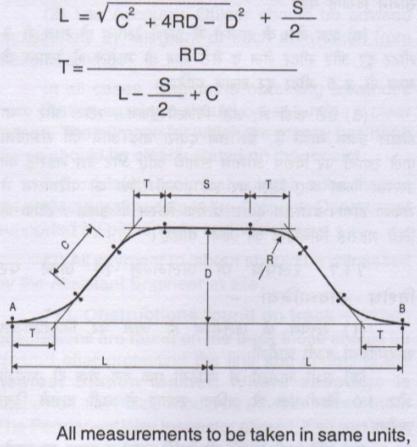
where
AB = Portion of existing line to be diverted.
L = Length of half the diversion, measured along the original alignment.
D = Maximum distance of diversion from original alignment.
S = Straight portion of diversion.
C = Length of straight between reverse curves.
R = Radius of curves.
T = Length of tangent.
(5) Opening for traffic - The diversion track should be adequately consolidated and tested by locomotive/ wagons before opening for traffic.
The most vulnerable portion of the diversion is at the junction of the old bank with the new bank. Care should, therefore, be taken to provide benching of slopes at the junction. Cross levels should be checked after passage of every train and rectified till the track gets stabilised.
(6) Issue of safety certificate- In an emergency the line may be opened to traffic on the safety certificate issued by the Engineer-in-charge, without the prior sanction of the C. R. S. However if the use of temporary diversion is likely to be extended to more than three days, the Commissioner of Railway Safety, may if he considers it necessary, take the earliest opportunity of inspecting it.
713. Transhipment - The decision, as to whether transhipment is to be done, is taken by Transportation/Commercial Department. If it is decided to provide gangways, footpath etc., purely for the purpose of transhipment, these should, as far as possible, be laid away from the site of repairs, so that the progress of restoration is not interfered with.
714. Funds required during Emergencies
- (1) The divisional Engineer or the Assistant Engineer on his behalf may draw upon the station earnings according to the instructions prescribed by the Administration under note to
(Para 1405-G) for the following purposes :-
(a) Payment to daily labour employment at the site of breach or accident.
(b) Purchase of tools or materials required in connection with accident which cannot be supplied in time by the Store Department.
(c) To provide food to engineering labour at the site of breach or accident with the assistance of Station Master or Inspectors of the Commercial Department.
(Supply of food free of charge is permitted in special circumstances at the discretion of the administration to facilitate expeditious restoration of traffic.
When food is supplied free at the site of an accident to engineering and other labour, the expenditure per head per day shall not exceed the prescribed limit).
(2) The Accounts Officer should be advised immediately by telegram of each sum taken from station earnings.
In all cases, Engineers obtaining advances from Station earnings should do so under a clear receipt. The purpose for which the money has been drawn should be clearly stated on the receipt.
A complete account should be submitted at the earliest possible date to the Accounts Department supported by pay sheets and vouchers.
(3) All payment to labour should be witnessed by the Assistant Engineer at site.
715. Obstructions found on track - When obstructions are found on the track those should be cleared after protecting the line and informing the nearest Station Master. Where sabotage is suspected, the Police should be advised immediately. The Permanent Way Inspector should, if so required, arrange to meet the Police Official at the place of occurrence. A detailed report should be submitted by Permanent Way Inspector to the Assistant/ Divisional Engineer. The Divisional Engineer should in turn report such occurrences whether or not sabotage is suspected to the Divisional Railway Manager and Chief Engineer.
716. Flooded Causeways / Dips -
(1) Permissible depth of water for passage of trains - In the case of causeways that are flooded and the velocity of current is insignificant, trains may be permitted to pass when the depth of water above rail-level does not exceed the following values, provided in each case Permanent Way Inspector has satisfied himself by walking over and probing that Permanent Way is intact and in a fit condition :-
|
Gauge |
Passenger and Mixed trains |
Goods train |
|
B.G. |
300mm. |
450mm. |
|
M.G. |
230mm. |
300mm. |
|
N.G. |
230mm. |
230mm. |
(2)(a) Indication posts- Indication posts about 1200 mm. in height shall be fixed at each dip, one at each end of the level portion, with flat bar attached to them to indicate level mentioned in
Para 716(1).
(b) The posts should be painted black and white in 300 mm. length so arranged that the flat bars which shall be painted white, show up against 300 mm. length of black colour.
(c) The posts shall be fixed 3 metres from the centre of the track in the case of Broad Gauge and 2.5 metres from the centre of track in the case of Metre and Narrow Gauge.
(3) In the section where electric locos/stock and or diesel locos ply, special gauges may be provided by the administration at the place liable to flooding, indicating the depth at which these locos/ stock have to be stopped from the operation. These depths should be specified for each type of locos/ stock by the administration.
717. Special precautions when track is submerged - (1) The following precautions shall be observed when the track is submerged :
(a) In all cases train shall be stopped dead and allowed to proceed at a speed not exceeding 10 km. p. h.
(b) If water rises over the top of the ballast but is below rail level, the track should be checked before each train, by two men walking abreast one at either end of the sleepers, and only if the track has not been disturbed, should the train be allowed over the track.
(c) When water overtops the rails, the Permanent Way Inspector shall pilot the train, after ensuring that the track is safe, by walking over the track and checking by means of probing, subject to depths specified in Para 716 not being exceeded.
(2) Telegraphic advise should be sent by the Permanent Way Inspector to the Assistant and Divisional Engineer, Divisional Railway Manager and Chief Engineer when water rises above ballast level and again when it subsides. This should be followed up by special reports to the Assistant Engineer and Divisional Engineer. Records of such occurrences should be entered in the Permanent Way Inspector's section register.
718. Driver's Report on Defects in Track
- (1) Intimation of defects-(a) When a driver reports to a Station Master that the track over which his train has passed is unsafe for the passage of any further train, with particulars of location, the Station Master will block the section concerned and issue a wire to the Permanent Way Inspector, copying it to the Assistant Engineer, Divisional Engineer and Control. No train will be admitted on the section concerned, until the Permanent Way Inspector has inspected the kilometrage and certifies to the Station Master that the section is safe for the passage of trains, specifying the speed restriction, if necessary.
(b) When a Driver reports to a Station Master that the track over which his train has passed requires a restriction of speed, with particulars of location, the Station Master will impose the speed restriction over the section concerned and issue a wire to the Permanent Way Inspector copying it to the Assistant Engineer, Divisional Engineer and Control. Caution orders will continue to be issued on the section concerned until the Permanent Way Inspector has inspected the kilometrage and certifies to the Station Master that the section is safe for passage of trains specifying the revised speed restriction, if necessary.
(2) Action on receipt of reports of defective track -
(a) By Permanent Way Inspector -
The Permanent Way Inspector shall -
(i) Proceed as quickly as possible to site, inspect the length of track reported on and record particulars in detail. Then arrange to rectify the track and remove or modify the restriction imposed, as found necessary.
(ii) Submit a detailed report to the Assistant Engineer and copy the same to the Divisional Engineer.
(b) By Assistant Engineer - Whenever possible, the Assistant Engineer should personally examine the track reported on for defects and make a detailed report to the Divisional Engineer.
719. Abnormal occurrences attributable to Locomotives and other Rolling Stock -
(1) Whenever distortion of track or any other abnormal occurrence attributable to locomotives or any other rolling-stock is noticed, the Permanent Way Inspector shall -
(a) Immediately impose speed restriction as necessary and arrange protection of the line as per rules.
(b) Report the occurrence by wire to the Loco Foreman concerned copying the message to the Assistant Engineer/Divisional Engineer and Divisional Mechanical Engineer, Control and Station Master on either side of the block section. Whenever possible, the number of engine/rolling-stock considered to be responsible for distorting the track should be given.
(c) Make a careful examination of the affected track with a view to finding out if any inherent weakness or defect in the track has contributed in bringing about the "abnormal occurrences", Particulars of defects should be noted in detail.
(d) Attend to defects as necessary and having done this, remove or modify the restriction as necessary.
(e) Submit a detailed report to the Assistant Engineer and copy the same to the Divisional Engineer.
(2) On receipt of intimation of any abnormal occurrence attributable to locomotive/Rolling-stock, Assistant Engineer should proceed to the site, examine the track minutely with reference to the report made by Permanent Way Inspector and submit a special report to the Divisional Engineer on the possible cause of damage with suggestion to prevent recurrence.
720. Accident not affecting through traffic-
(1) The Permanent Way Inspector should immediately proceed to the site of the accident and take such measures, as necessary, to clear the obstruction and restore the line.
(2) The accident report in the prescribed form together with a sketch and statements of track particulars taken over sufficient length should be submitted in duplicate by the Permanent Way Inspector to the Assistant Engineer who will forward one copy of the report to the Divisional Engineer with remarks.
Accident reports should be scrutinised by the Divisional Engineer in all respects with particular reference to the time taken in restoring the line. Such instructions may be issued by the Divisional Engineer to the Assistant Engineers and Permanent Way Inspectors and to other departments, as may be deemed necessary.
The accident report form shall include particulars of date and time, kilometerage, description of accident, cause if known, number and type of train, engine, vehicles involved, names of Drivers and Guards, extent and cost of damage to the permanent way and rolling stock, time of restoration and the Permanent Way Inspector's special remarks. Accidents such as damage to the gate leaves/barriers by road vehicles, cattle run over and fire in which track is not affected, should be reported separately.
(3) As far as possible the Assistant Engineer should proceed to the site of accident of sufficient importance, such as derailments on running lines, gathering lines and of locomotives.
721. Records of accidents - (1) Apart from individual files, all important accidents, breaches, washouts and subsidence of track should be carefully recorded with complete particulars in the section register by Permanent Way Inspector.
(2) In the case of damage by flood at important bridges, detailed particulars with remedial measures adopted should be entered by Assistant Engineer in the Rivers and Floods Register and reference made thereto in the Bridge Inspection Register.
(3) Records of all the accidents should be maintained systematically in the offices of Permanent Way Inspectors, Assistant Engineer and Divisional Engineer so as to facilitate supply of statistical and other information as may be required.
722. Accident statements to the Railway Board - (1) Returns of the accidents under specified categories are compiled by the Operating Departments for submission to the Railway Board. Relevant particulars should be promptly furnished by the Divisional Engineer and Works Manager/ Deputy Chief Engineer of Engineering Workshops to the proper authority on such forms as may be prescribed.
(2) Workshop accident fall under Factories Act and should be reported according to the rules in force and to such local authority as may be specified.
PART 'B'
Pre-Monsoon Precautionary Measures
723. General precautions to be taken before monsoon - It is necessary to take certain precautions, and carry out certain essential works before the commencement of monsoon, such as
(1) All catch water drains and side drains must be cleared of silt, vegetation and other obstructions to ensure free flow and quick drainage of storm water.
The waterways of bridges must be cleared of vegetation and other obstructions. If silting is noticed in some spans, it should be removed to ensure that the full waterways is available for the discharge of flood water. During desilting, care should be taken to remove the silt only upto the bed level.
(2) Protective and river training works must be maintained in good condition and repairs carried out wherever necessary. Scour holes should be filled with boulders.
(3) The High Flood Level (HFL), Full Supply Level (FSL) in the case of canals, and Danger Level (DL) must be painted. The danger level mark shall be painted with bright red band across each pier adjacent to the abutment so as to be clearly visible to the Patrolmen, Special Watchmen and Drivers. Flood gauges shall be painted on important bridges as specified.
(4) Water shall not be allowed to stagnate on the track. For this purpose, cross drains should be provided at regular intervals. In yards, cross drains and longitudinal drains should be cleared/provided to proper grades.
(5) In hilly areas, where there is incidence of falling boulders, a survey should be carried out to locate loose boulders. Such loose boulders should be dropped in a systematic manner.
(6) Selection of Patrolman and Watchman should be made in accordance with Para 1008 and they must be trained and tested for their knowledge of rules. The duties to be performed by them should be clearly explained to them.
The equipment of Patrolmen and other watchman shall be complete in all respects.
(7) Spare trollies should be kept in readiness at the headquarters of the Permanent Way Inspector and at other stations in the proximity of vulnerable
locations. Motor Trollies must be overhauled and kept in fit condition.
(8) Rivers in the upstream reaches should be inspected for guarding against possible change in water course.
(9) The prescribed reserve stock of boulders, empty cement bags, wire netting and sand/quarry dust should be kept at specified locations for rushing to site, in case of emergency and should be made good, in case of deficiency.
(10) Action should be taken as envisaged in Para 726(3) in the case of Railway affecting works.
(11) The temporary Engineering indicators must be painted and kept ready for use.
(12) The rain gauges should be inspected before the monsoon and it should be ensured that they are in perfect working condition.
(13) Vulnerable locations/kilometrages should be reviewed jointly by the Assistant Engineers and Divisional Engineers and on the basis of past history and pre-monsoon inspections and the register of vulnerable locations should be brought up-to-date.
724. Materials for Emergencies - (1)
Arrangements should be made to stock sufficient quantities of rails, sleepers, materials for cribs, ballast, sand/quarry dust and boulders at suitable points near vulnerable locations, so that the materials may be rushed to site as required.
(2) Before the onset of monsoon, specified number of wagons loaded with sand/quarry dust, ballast and boulders should be kept at appropriate stations for quick movement to vulnerable locations."
(3) During monsoon, as far as possible, ballast train should be programmed to work in the vicinity of the vulnerable zones so that they may be utilised without delay in emergency.
(4) Locations and quantities of reserve stocks should be made known to all Divisional Engineers and Assistant Engineers by the Chief Engineer. Reserve stock should not be used except in an emergency. When it is used, it should be recouped.
Divisional Engineer should send a certificate to the Chief Engineer to the effect that monsoon reserve stock is in order and to the scale laid down, by the prescribed date.
(5) Bridge Engineer/Divisional Engineer should arrange to keep equipment like service spans, trestles, cribs, derricks, compressor, equipment and materials required for blasting, pavement breakers, welding sets etc., ready for use in emergencies. These should be stocked at convenient places so that they can be despatched to the site of breaches without delay.
725. Service Spans and Rail Clusters
(1) Service spans - details of temporary service spans available on each railway should be listed and circulated for the guidance of Assistant Engineers and Divisional Engineers before the monsoon.
(2) Rail Clusters- It is some times necessary to provide rail clusters to pass traffic in emergencies. Rail cluster may be used as a temporary measure in emergency subject to following conditions :-
(i) Speed restriction shall be 10 km. p. h.
(ii) Rails forming clusters must be clamped together with head and foot alternatively.
(iii) Rail cluster must extend over the full dimension of the sleeper crib and must be spiked to the top sleepers. Drawings showing details of section of rail/ No. of rails/clear span to be used under each running rail, shall be issued by the Chief Engineer of the railway for the guidance of Permanent Way Inspectors and Assistant Engineers, who should be in the possession of the same.
726. Railway Affecting Works (including Railway Affecting Tanks) - (1) Definition-The term "Railway affecting Work" may broadly be taken to mean any work which if not constructed and maintained properly, or not operated properly may result in danger to Railway Line (Bridge/ embankment). This may include tanks, storage works, canals, bunds, etc.
(2) Register of Railway affecting works - The Divisional Engineer/ Assistant Engineer will maintain an up-to-date list of Railway affecting works as jointly approved by the Railway and the state Government. The list shall invariably show the particulars of state Authority responsible for maintenance of each railway affecting work.
(3) Inspection of Railway affecting tanks -Where as per current practice the Public Works or
Revenue Department forwards to the Divisional Engineer every year, their inspection reports on the condition of these tanks which are classified as Railway affecting, action should be taken as follows:-
(a) The Divisional Engineer should peruse the reports carefully and mark those tanks which he considers are not in satisfactory state of repair. He should then forward the reports to the Assistant Engineer with instructions that the tanks so marked should be inspected and reported on.
(b) The Assistant Engineer should inspect those tanks and report to the Divisional Engineer details of the action being taken by the Public Works or Revenue Department. The Divisional Engineer should prevail on the authorities concerned to carry out all necessary repairs before the ensuing monsoon.
(c) Copies of the inspection notes of 'Railway Affecting' tanks as received from the Public Works or Revenue Department with particulars of date of inspection and notes of action taken or proposed by him should be included in the Register of Railway Affecting Works maintained by the Assistant Engineer.
727. Vigilance over Railway Affecting tanks during heavy rains - (1) the Divisional Engineer and the Assistant Engineer should arrange with the local authorities/village headman in whose jurisdiction 'Railway Affecting' tanks are situated to watch them during periods of heavy rain and give timely intimation to the nearest Station Master, if there is likelihood of any tank failing. The Station Master will telephone/telegraph reports received from village Headman to the Permanent Way Inspector, Assistant Engineer and Divisional Engineer.
(2) When the railway line is threatened, the Assistant Engineer and Permanent Way Inspector shall take adequate steps to ensure the safety of Railway property and staff and arrange patrolling of the line and or post watchmen with necessary equipment at the place or places threatened and advise the Divisional Engineer accordingly.
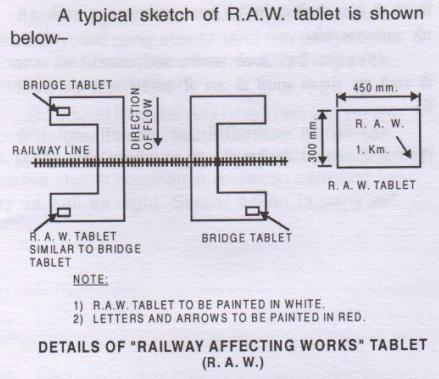
(3) All the Bridges which are likely to be affected by Railway affecting tanks or other storage works should be provided with a tablet on top of one of the parapets, with the letters RAW engraved on it, followed by an arrow mark pointing in the direction of the railway affecting storage work in question.
A typical sketch of R.A.W. tablet is shown below-
(4) If the bridge in whose catchment a Railway affecting tank is located is classified as a vulnerable location, stationary watchmen should be posted during monsoon. If for any reason, repairs as envisaged during the inspection, as per
Para 726(3) is not carried out, the section of the Railway line likely to be affected should be considered as vulnerable and watchman as considered necessary posted.
728. Weather warnings and action to be taken - (1) General- (a) Arrangement should be made with the concerned Meteorological Centre for receipt of bad weather warnings.
(b) The bad weather warnings to be received should cover both high velocity winds and cyclones as well as heavy rainfall and arrangement should be made for receipt of the same throughout the year.
(c) The list of Officers who should receive the bad weather warnings and their addresses should be discussed at personal level with the Meteorological Department. The list should be reviewed and updated every year.
(d) Detailed instructions and full-proof arrangement should exist for prompt communication of bad weather warnings on receipt to the line staff.
(e) Anemometer should be installed at one of the adjacent stations of specially selected bridges where very high velocity winds are experienced and where there is a danger of vehicles capsizing.
(f) Suitable working rules should be framed prescribing for each location the danger level of wind velocity and enjoining upon the Station Master to control (stop) the traffic on the section concerned
when the wind velocity exceeds the danger level and also to inform the Station Master on the other side and the Section Controller of the need to control the traffic.
(2) Precautions to be taken by Station Master, Driver and Guard - Regarding controlling of trains -(a) When a weather warning message has been received forecasting heavy or cyclonic storm and there is reasonable doubt that a severe storm and high winds are going to break through, that may endanger the safety of passengers/ train, the Station Master may, in consultation with the Guard and Driver, detain the train until the storm and high winds abate and it is considered safe to allow the train to proceed from his station.
(b) In spite of the action outlined above should the Driver be still caught on run in a storm and high winds of an intensity which in his opinion are likely to endanger the safety of passengers/ train, he should bring his train with the least delay to a halt, avoiding such stoppage at places like sharp curves, high embankments, cuttings and bridges. The train could be restarted in consultation with the Guard only after the storm and high winds abate and it is considered safe to proceed.
(3) Action by the P.W.I - (a) The Permanent Way Inspector on receipt of weather/cyclone warning, should arrange to advise monsoon patrolmen/ watchmen and Gang Mates to be extra vigilant.
During the fair season, he should introduce monsoon patrolling as soon as possible and also post watchman as required at all vulnerable locations and bridges by day as well as by night for a period extending upto 48 hours beyond the period specified in the weather/ cyclone warning message.
(b) The Permanent Way Inspector should be out in his section as far as possible by trolley during the period of warning and 48 hours beyond.
(4) Action by the Gang Mates - On receipt of advice from the Station Master the Gang Mate should take the following action :- (a) During the fair season, the Mate of station yard gang should depute two reliable gangmen provided with patrolmen's equipment for patrolling the block sections on either side and for alerting the intermediate Gangmates.
(b) During monsoon period also the Mate of the station yard gang should send two gangmen in opposite directions to alert intermediate Gangmates, patrolmen and watchmen.
(c) Should there be very heavy rain or a severe storm weather during the monsoon or fair season, the Mate and Gangmen of all gangs on their own initiative should commence monsoon patrolling by day as well as night. Similar action to carry out
patrolling should be taken on receipt of bad weather warning for the duration of warning and 48 hours beyond.
(5) The individual Railway may issue instructions in the form of joint circular to suit the local requirements.
(6) Inspecting officials should test the knowledge of Gang Mates and Gangmen about these instructions issued.
The following details are to be shown on the dimensioned sketch to be prepared in the case of accidents :
(1) The train number, the date and kilometerage of site of accident should be furnished.
(2) The North point should be indicated.
(3) It should indicate prominently the direction of movement, and also the names of stations in rear and advance of the accident site.
(4) It should a cover a length of about 300 meters behind the point of mount an almost an equal distance in front.
(5) Each track of the Permanent Way must be denoted by a pair of lines.
(6) The position of level crossings, Telegraph posts/ Electrical posts, Bridges, Tunnels, Gradient posts with Gradient symbols, curves, demarcating the beginning and end, giving details of degree of curvature, prescribed super elevation and length of transitions should be indicated.
(7) It should also indicate the position :
(a) of all derailed vehicles and the marks left by them either on sleepers, rails or ballast,
(b) of the point of mount with position of rail joint on either side,
(c) of the point of drop,
(d) of the pair of wheels of the first derailed vehicle,
(e) in which every displaced rail/ wagon or part of a rail/wagon and detachable components were found.
Note - In all cases, dimension from nearest kilometre post and centre line of track should be given.
(8) In case of accidents within station limits, sufficient details about the station layout should be shown in order to fully explain the movement of the affected train in relation to the topography of the place. The signal aspects at the time of accident should be correctly depicted.
ANNEXURE 7/1 (Para 707)
(9) The distance of the site of accident from a permanent structure to fix the site of accident precisely should be indicated.
(10) The distance should be indicated to show the extent of the disturbance caused in the Permanent Way or train composition on account of the accident.
(11) Any marks on sleepers or other track fittings should be clearly indicated in their exact position in relation to the track or vehicles.
(12) Broken parts of other extraneous material, if found on the site of accident, should be shown in the sketch, with details giving their precise position in relation to track.
(13) If necessary, more than one sketch should be enclosed one clarifying the yard layout and the system of working it and the other giving details, such as, position of wheels, wheel marks etc. In the former, one line should be used to represent both rails of track and such position of the station yard (in case of accidents within station limits) should be covered as may be necessary. All necessary details relevant to the issue must be embodied in the sketch. The terminal station on the down side should be mentioned on the right extremity of the sketch, the terminal station on the up side being mentioned on the left extremity. If the accidents take place within station limits the shorter sketch should be based on the station working diagram.
(14) Details of track structure should be shown in the sketch.
(15) Details of damages to bridges involved, spanwise should be shown.
(16) In the case of accidents to and near level crossings, full details of the level crossings should be furnished.
(17) Any other details as may be considered necessary to reconstruct the scene of the accident should also be shown.
ANNEXURE-7/2 PARA 708 (1)
PART - A
Pro forma showing the detailed particulars to be collected in the case of Permanent Way during an Accident
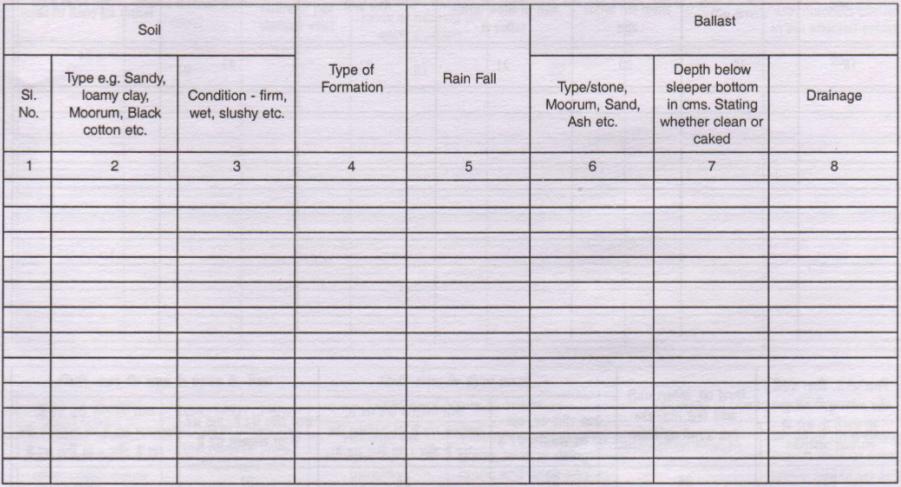
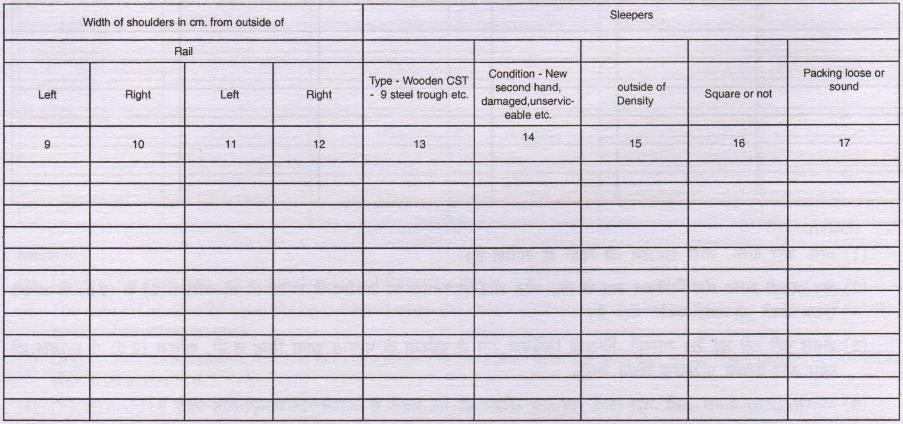
ANNEXURE-7/2 Contd...
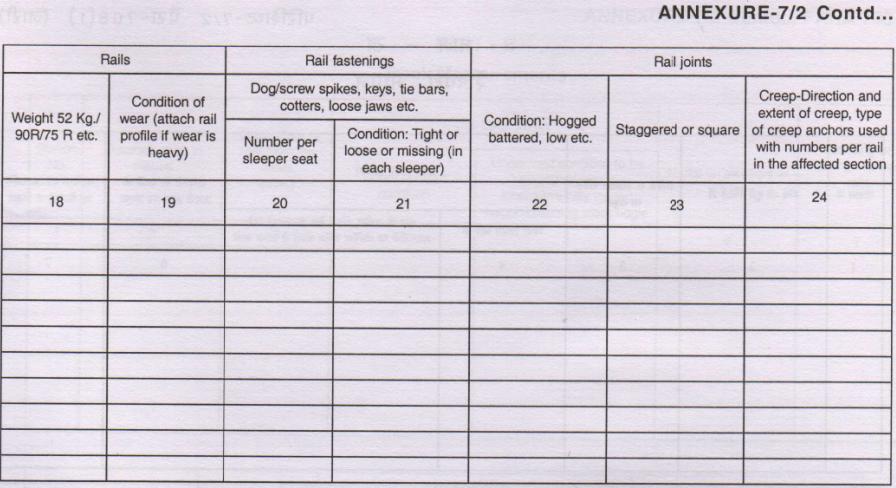
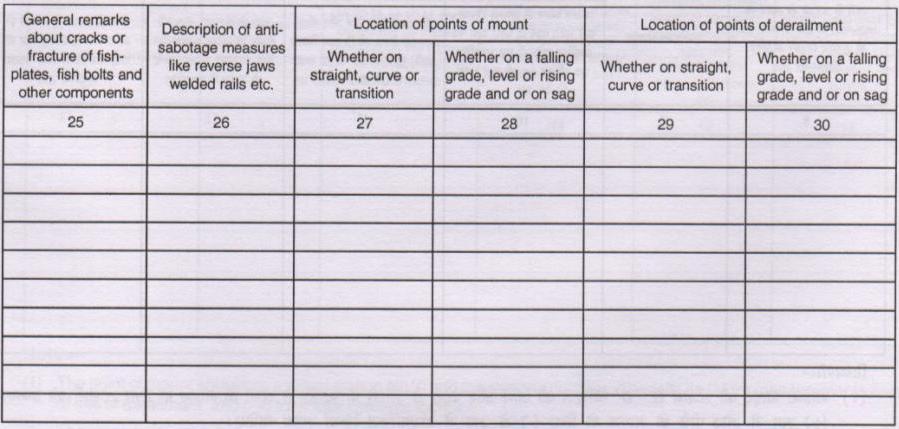
Note -
(1) Left and right are with respect to direction of Train movement.
(2) The data in Col. 2 to 25 need not be collected when the defect is obviously and indisputably on account of sabotage and/or obstruction on track.
(3) Only broken track material which is not indisputably to be broken after the accident should be included in Col. 25 and should be preserved.
(4) Col. 26 need be filled in only when there is a suspicion about sabotage being the cause of derailment.
(5) Sag extends 90 metres on either side of theoretical junction of the grade lines Col. 28 and 30.
ANNEXURE-7/2 Contd... PARA 708 (1)
PART - B
Track Measurements
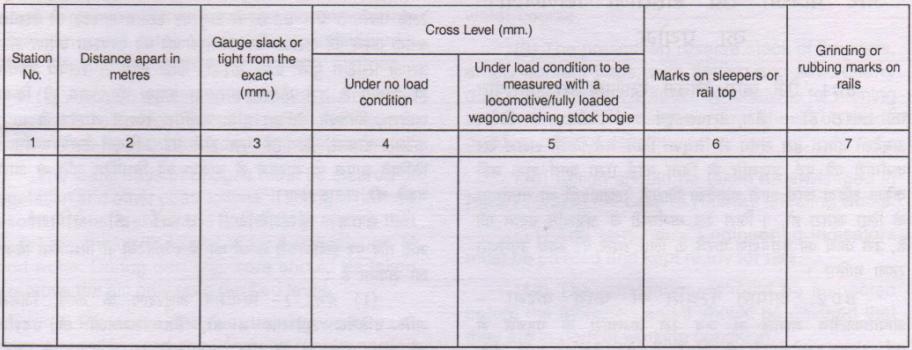
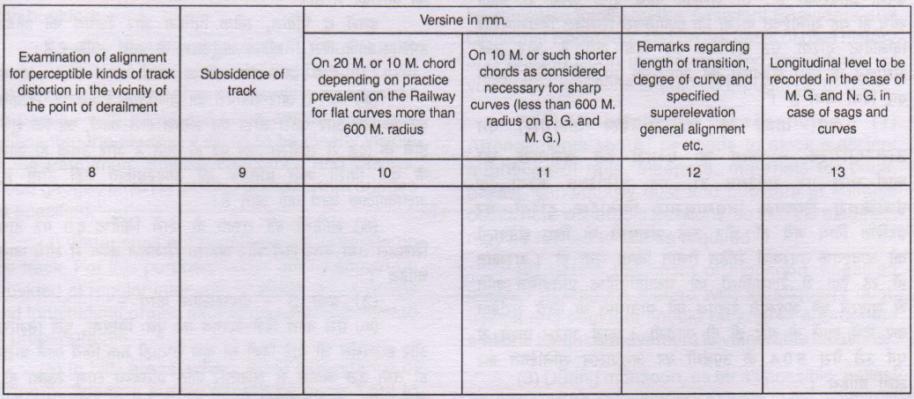
Note -
(1) The point of mount should be marked station No. 0 and the stations numbered serially as (+) for measurements ahead of site of derailment and (—) for measurements in rear.
(2) The cross level will be measured on the left rail only as determined from the direction of movement.
(3) Normally measurement will be taken at station 3 M. apart for a distance of 45 metres on either side of 0 station if the cause of derailment is indisputably known, otherwise they will be taken for a distance of 90 metres in rear and 45 metres ahead of zero station.
(4) Where necessary measurements for Col. 3,4 and 5 may in addition be taken at individual sleepers.
(5) This proforma need not be filled when the cause of derailment is obviously established as due to sabotage, obstruction on track, broken axle, and/or spring having fallen off prior to point of derailment.
(6) Longitudinal levels should be recorded for 300 metres on rear and 100 metres in front, in case of straights at the middle of each rail and at versine recording points on curves @ 20/10 M intervals.
|